

In radiation oncology, innovation often invokes advanced technologies, clinical trials and precision treatments. But sometimes, meaningful progress begins in the most unexpected places — like the back closet of a rural radiation oncology clinic in northern Vermont.
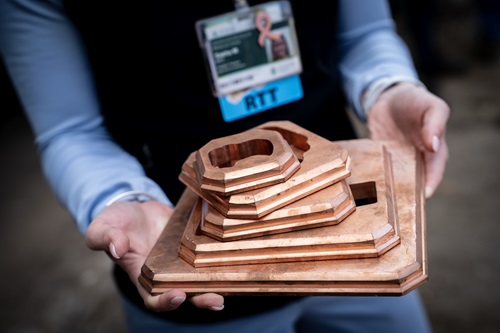
Earlier this year, radiation therapists Sam Bickerton and Sasha Morton, who practice at Dartmouth Cancer Center - St. Johnsbury, noticed something during a routine effort to tidy their workspace: shelves overflowing with unused copper electron cutouts. These personalized cutouts — once common in electron treatments — are now tailored to each patient and rarely reused. Over the past decade, they had quietly accumulated, holding no ongoing clinical utility but representing valuable material.
Sam and Sasha wondered: Could this overlooked “waste” be recycled into something meaningful for patients? Their answer ultimately transformed 488 pounds of copper into more than $1,600 donated directly to The Prouty, the region’s signature cancer fundraiser supporting patients and programs across Dartmouth Cancer Center.
Their initiative not only reimagined what environmental sustainability in radiation oncology is but also established a model that can be replicated across departments nationwide.
From Cluttered Shelves to Community Impact
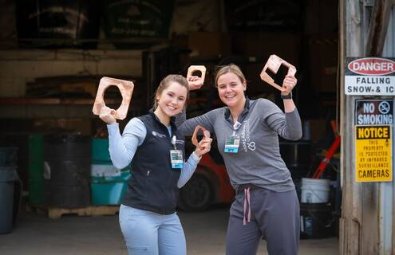 As Sasha recounted in our interview, the idea started: “I had just renovated my house and learned that scrap copper has real value. I looked at Sam and said, ‘Do you know how much money is sitting right here?’”
The St. Johnsbury team consulted their physicists and quickly learned that there were no restrictions, and no prior plans, for the accumulated cutouts. In fact, Dot Decimal, the manufacturer, notes on its website that clinics are encouraged to recycle them.
With the green light in hand, Sam and Sasha researched local recycling facilities, identified the best price, loaded their car after clinic hours, and hauled nearly 500 pounds of copper to a regional scrapyard. The recycler was so moved by their story that he personally contributed an additional $50.
“That was my favorite part,” Sam shared. “We made an impact on someone outside our clinic — just by doing something simple and meaningful.”
Their donation to The Prouty directly supports patient needs including a new on-site laboratory at the St. Johnsbury clinic, an essential addition for this rural center, where many patients travel long distances for care and routinely face transportation challenges.
Why This Matters for Radiation Oncology
The copper initiative highlights two themes increasingly relevant to the radiation oncology community:
- Easy-to-implement sustainability opportunities are everywhere.
Like all fields in medicine, radiation oncology inevitably generates environmental impact through energy-intensive buildings, patient travel and clinical supply chains — an issue recently quantified in The Lancet Oncology and highlighted in the Green Journal. While systems-level changes are essential, frontline teams often identify the most immediate opportunities to reduce waste, repurpose materials and reinvest in patient care. - Small actions can inspire culture change.
As Derek Maillet-Rust, MBA, St. Johnsbury Practice Manager, reflected: “I never would have thought of this myself. What Sam and Sasha did showed the power of engaged staff — you don’t need a formal leadership role to make something happen.”
The initiative also aligns with the broader movement within ASTRO to integrate care access, sustainability and equity into practice. Recent ASTROblog pieces addressing wildfire resilience and climate-related challenges emphasize the need for creative, locally led approaches to strengthening the systems that support patient care.
A Call to Action for the Radiation Oncology Community
Perhaps the most compelling aspect of this story is its scalability. As Sasha shared: “There are recycling centers across the United States. Why couldn’t every radiation oncology clinic do this?”
With over 15,000 linear accelerators worldwide, the potential for collective impact is significant. Although electron cutouts are used less often nowadays, they remain common in many clinics. Developing a straightforward workflow for collecting, storing and recycling unused copper could lead to:
- Meaningful donations to patient support funds
- Opportunities for clinic-level sustainability engagement
- New models for community partnership
- A shared sense of purpose across clinical teams
As Sam put it: “This gave us an even greater sense of purpose. It reminded us why we’re here — our patients.”
Charles R. Thomas, MD, FASTRO, Chair of Radiation Oncology & Applied Sciences at Dartmouth Cancer Center, reflected on the initiative, “Sam and Sasha’s work shows that innovation in cancer care doesn’t always require new technology; sometimes it begins with noticing value where others see waste. Their leadership embodies the best of our profession, and I’m personally excited to work alongside such creative and committed professionals in our North Country clinic.”
Join Us in the Spirit of Giving
Inspired by Sam and Sasha’s initiative, we invite departments across the country to:
- Launch a copper recycling effort of your own, whether to support local patient funds, community organizations or cancer center initiatives.
- Support the causes highlighted in this story:
- Donate to The Prouty, supporting Dartmouth Cancer Center patients, or your own local patient support organizations.
- Donate to the Radiation Oncology Institute (ROI), fueling research that strengthens the future of our field
These small steps — multiplied across our community — can transform the way we think about patient care, sustainability and giving in radiation oncology.
Thank you for all you do for patients and for each other.
Blog commenting guidelines
- Commenters are required to identify themselves by name. Email verification is required for first time commenters.
- Comments are subject to review and should focus on the content of the blog post or other posted comments. Comments that are commercial or promotional in nature, are not relevant to the blog for which they have been submitted or are otherwise inappropriate will not be posted.
- All defamatory, abusive, harassing, profane, threatening, offensive, pornographic, obscene or illegal materials are strictly prohibited.
- Providing any non-public information about ASTRO or any other company or persons without authorization is prohibited.
- To preserve a climate that encourages both civil and fruitful dialogue, ASTRO reserves the right, in its sole discretion, to delete posts or ban users who violate these rules.
