2025 ASTRO Member Survey Results
By ASTRO CommunicationsThe ASTRO Annual Member Survey provides a snapshot of our membership in addition to valuable feedback about areas of concern and opportunities for improvement. Members provide feedback on ASTRO membership satisfaction and functions, current challenges, future opportunities, and radiopharmaceutical therapy. The 2025 Member Survey was fielded for nine weeks from April 28, 2025, through June 27, 2025, and was emailed to 8,569 members. The survey had a 10% response rate with two-thirds of respondents identifying as radiation oncologists (ROs). The results of the survey follow:
PROFESSION
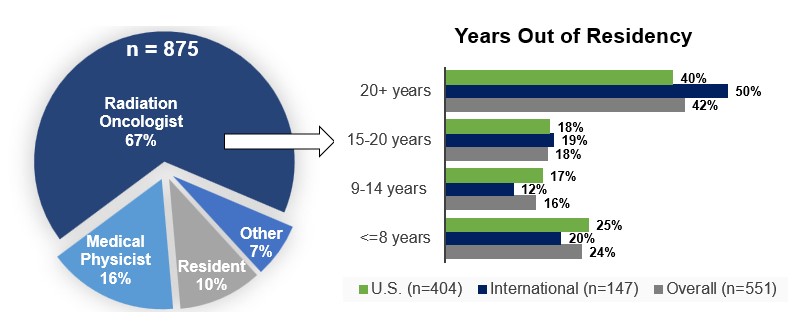
Out of the 875 respondents, 67% are ROs, 16% medical physicists, 10% residents and 7% other. Seventy-seven percent of respondents are U.S.-based. Taking a closer look at participating radiation oncologists based on years out of residency, those who are more than 20 years out of residency and those less than or equal to eight years out of residency were the most highly engaged in completing this survey. Thirty-seven percent of the 433 U.S. ROs reported that they are the medical director at their primary work setting.
PRACTICE SETTING
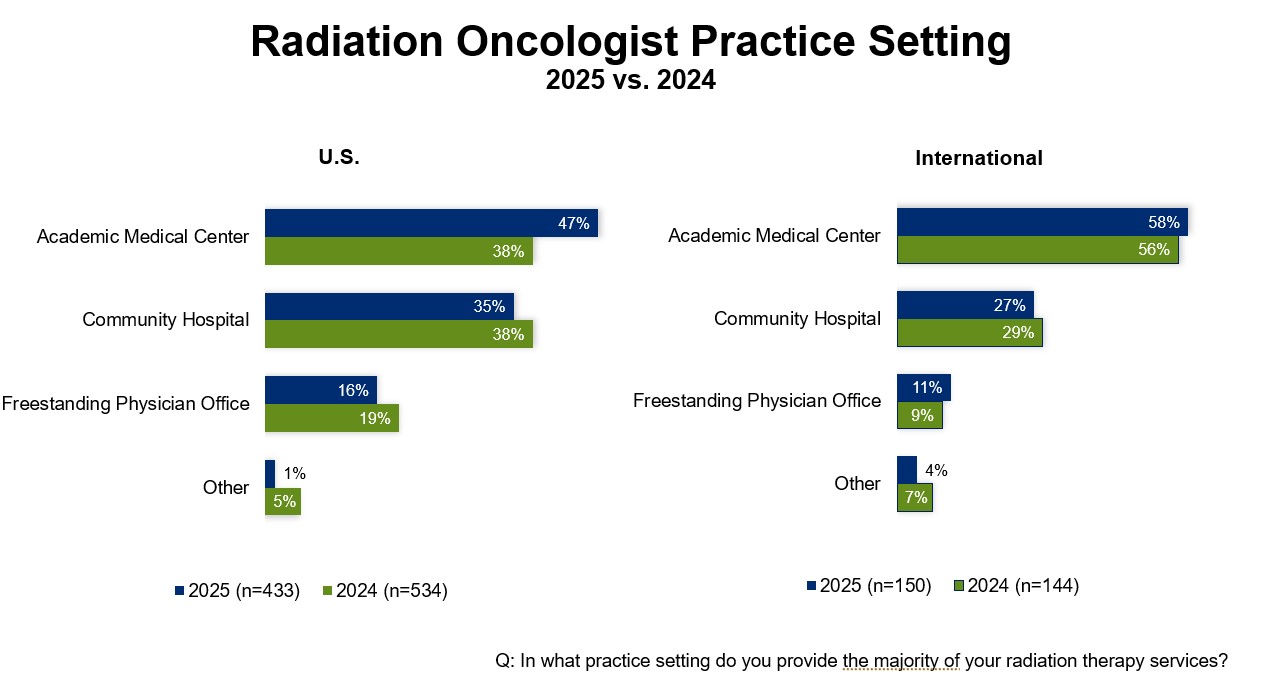
When ROs were asked, “In what practice setting do you provide the majority of your radiation therapy services,” Academic Medical Center and Community Hospital topped the list for both U.S. and International respondents. However, a noticeable increase in U.S. RO respondents reported practicing in Academic Medical Centers in 2025 vs. 2024 (47% and 38% respectively). International RO respondents practice setting responses were consistent year over year.
PRIMARY EMPLOYER
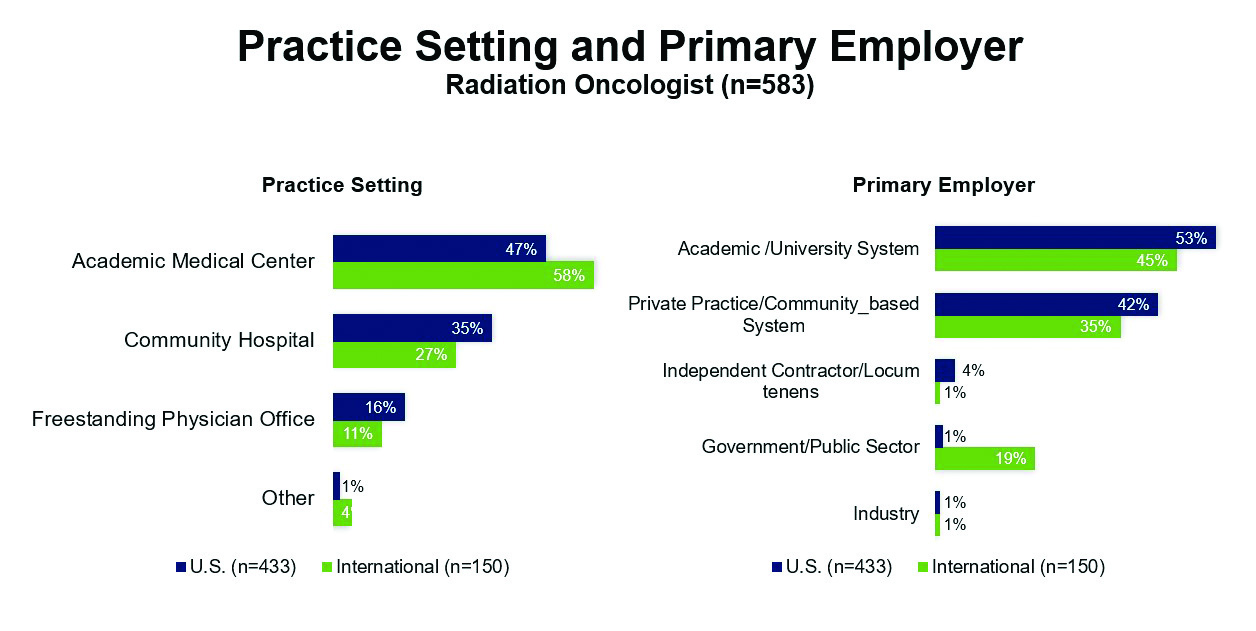
More than half (53%) of U.S. ROs reported their Primary Employer is Academic/University-based system and 42% reported Private Practice/Community-based system. ASTRO U.S. physician membership is 46% Academic/University-based, 49% Private Practice/Community-based, 2% Government and 3% Other.
MEMBERSHIP AND SATISFACTION
In response to the question, “What are your top three reasons for being a member of ASTRO,” both U.S. and international respondents rank Access to ASTRO Journals and Premier Society for Radiation Oncology as the top two reasons. U.S. respondents rank Networking Opportunities as number three, while International respondents rank Quality and Safety Recommendations, e.g., guidelines and whitepapers third. Publishing Scientific and Practice Journals and Advocating on Behalf of Members for Appropriate Reimbursement and Coverage rank as top functions ASTRO performs by U.S. ROs (89% and 86% respectively). Top ASTRO functions from the International ROs perspective are Publishing Scientific and Practice Journals and Hosting the Annual Meeting (79% and 72% respectively).
| U.S. | 2025 (n=424) |
|---|---|
| Publish scientific and practice journals (Red Journal, PRO and Advances) | 89% |
| Advocate on behalf of members for appropriate reimbursement and coverage (e.g., insurers, CMS) | 86% |
| Educate and lobby Congress and policymakers about radiation oncology | 86% |
| Host the Annual Meeting and specialty meetings | 83% |
| Support the delivery of safe and effective patient care (e.g., publish clinical practice guidelines and consensus documents) | 82% |
| International | 2025 (n=147) |
|---|---|
| Publish scientific and practice journals (Red Journal, PRO and Advances) | 79% |
| Educate and lobby Congress and policymakers about radiation oncology | 72% |
| Host the Annual Meeting and specialty meetings | 63% |
| Support the delivery of safe and effective patient care (e.g., publish clinical practice guidelines and consensus documents) | 52% |
Overall satisfaction among respondents increased in 2025. Looking at U.S. and International satisfaction separately also indicates an increase in satisfaction. The greatest jump in satisfaction is noted by U.S. Early Career respondents whose satisfaction increased from 48% in 2024 to 67% in 2025. U.S. Resident satisfaction also indicates a slight increase in 2025. Both ARRO and Early Career now have ex-officio seats on the ASTRO Board of Directors, which may account for the increase in satisfaction.
Current Challenges
This year’s survey asked various U.S. populations about the issues they face. The following are the top three challenges reported by each group:
Academically Affiliated Community Radiation Oncologists
- Financial pressure and decreasing reimbursement: Declining reimbursement, rising costs, and misaligned compensation. Difficulty funding research, upgrading equipment, or supporting staff due to budget constraints.
- Staffing shortages and administrative burden: Insufficient clinical and research staffing, overwhelming administrative tasks such as prior authorization, documentation and insurance approvals which reduce time for patient care, research, and academic duties.
- Access, integration and academic infrastructure gaps: Difficulty in accessing clinical trials, research support, equipment and specialty services – especially at satellite or non-main sites. Poor coordination with academic centers and lack of protected time or institutional support.
Private Practice/Community-based Radiation Oncologists
- Administrative and financial barriers: Time management, insurance issues, bureaucracy and financial constraints that affect operations and patient care.
- Clinical and operational challenges: Overloaded patient numbers, staff shortages, limited access to advanced technology and poor integration between specialists, all impacting treatment quality and patient outcomes.
- Systemic and structural issues: Problems related to research infrastructure, competition between centers and the decentralization of care, as well as economic and system inefficiencies.
Rural Radiation Oncologists
- Access to care and workforce shortages: Access to timely care due to transportation challenges, limited access to specialists and weak referral networks. Staffing shortages across roles (physicians, RTTs, nurses, engineers) hinder care delivery and increase provider burnout.
- Financial and operational strain: Declining reimbursement, unfavorable insurance mixes, and rising equipment and staffing costs. Many centers also struggle to afford necessary capital upgrades, maintain aging technology and meet increasing administrative demands.
- Administrative and clinical burdens: Providers are overwhelmed by prior authorization requirements, documentation demands, and supervision rules that take time away from direct patient care. Shifting treatment paradigms and decreasing indications for radiation further complicate clinical decision making and long-term planning.
Physician Scientists
- Unstable and inadequate research funding: Declining NIH support, limited non-federal and pharma funding, increasing competition and shifting priorities.
- Erosion of protected time and increasing clinical burden: Increased patient loads, staffing shortages, RVU expectations and administrative burdens are reducing time available for research.
- Workforce and infrastructure: Clinician-scientists are overwhelmed trying to juggle clinical care, academic research, and institutional responsibilities, with little institutional relief, undermining long-term career sustainability.
Social Media Preferences
Social media is a frequent tool ASTRO uses to communicate important and timely information. The survey asked members which social media platform they used most for professional purposes. LinkedIn ranked first for both U.S. and International respondents.
| Social Media Platform | U.S. (n=463) | International (n=154) |
|---|---|---|
| 56% | 50% | |
| X (Twitter) | 30% | 20% |
| 7% | 17% | |
| 5% | 12% | |
| BlueSky | 3% | 1% |
RADIOPHARMACEUTICAL THERAPY (RPT)
ASTRO continues to provide educational opportunities on the topic of radiopharmaceutical training. Coming in 2026 are the Multidisciplinary Radiopharmaceutical Therapy Symposium, Learning Collaboratives and Authorized User Training Centers.
Fifty-six percent of U.S. Medical Director respondents reported that their practice uses unsealed sources to treat patients with cancer. Sixty-seven percent of U.S. radiation oncologist respondents reported they are an authorized user who uses radioactive materials. More specifically, 89% indicated authorized user status for sealed sources and 65% for unsealed sources.
FUTURE OF THE FIELD
U.S. and International ROs, RO residents, and medical physicists shared what they are most excited and concerned about with regard to the future of the field.
| Radiation Oncologists | ||
|---|---|---|
| U.S. | Excited | Concerned |
| Technological Innovation and Precision Medicine | Reimbursement and Payment Models | |
| Expansion of Radiation Therapy Applications | Workforce and Training | |
| Combination Therapies and Integration with Systemic Treatments | Technological Relevance and Advocacy | |
| International | Integration of AI and Personalization | Workforce Shortages and Training Gaps |
| Advanced Techniques and Technologies | Financial and Accessibility Challenges | |
| Combination with Systemic Therapies | Impact of AI and Technological Advancements | |
| Radiation Oncology Resident | ||
|---|---|---|
| U.S. | Excited | Concerned |
| Technological Advancements and Innovation | Decreasing Reimbursement and Financial Pressures | |
| Expanding Indications and Applications | Workforce and Job Market Challenges | |
| Patient-Centered Care and Improving Outcomes | Loss of Influence and Role in Cancer Care | |
| International | Technological Innovation in Radiation Therapy | Global Disparities in Access to Advanced RT |
| Equity and Accessibility in Healthcare | Job Opportunities and Career Pathways | |
| Collaboration Across Disciplines | Toxicity and Side Effects of Radiation | |
| U.S. Medical Physicist | ||
|---|---|---|
| U.S. | Excited | Concerned |
| AI-Driven Precision and Adaptive Radiotherapy | Financial Pressures, Reimbursement, and Cost Sustainability | |
| Integration of Multi-Modal Treatments and Collaboration | Workforce Issues: Staffing Shortages, Burnout, and Training | |
| Technological Advancements for Improved Access and Efficiency | Technological and Clinical Advancements: AI, Safety, and Innovation Stagnation | |
The Annual Member Survey provides valuable information for ASTRO’s continued service and future initiatives. Thank you to everyone who participated in the 2025 survey. The survey is sent out every spring, so please help us continue to serve the needs of the radiation oncology community by completing the 2026 survey.