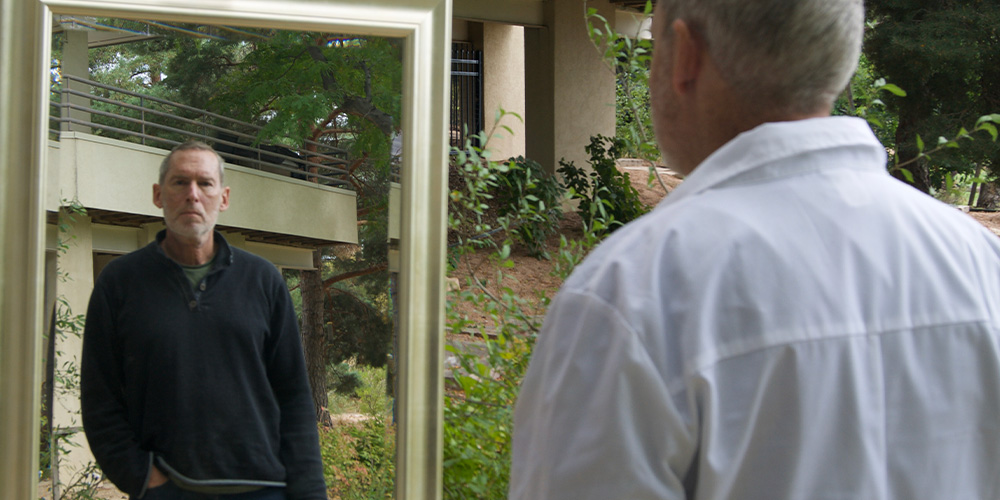
P.S. Your Shoes are Untied
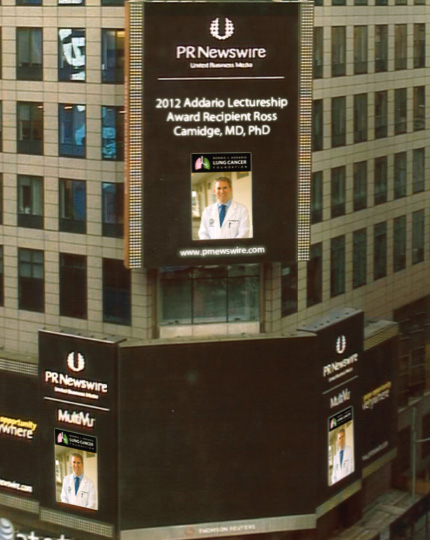
Brian Kavanagh, MD, MPH, FASTROProfessor Ross Camidge, MD, PhD, serves as National Medical Director of the Academic Thoracic Oncology Medical Investigators Consortium (ATOMIC), holds the Joyce Zeff Chair in Lung Cancer Research at the University of Colorado, and has authored over 500 scientific papers (many in NEJM, Lancet and JCO) with over 73,000 citations and an h-index of 113. He is the winner of many lung cancer research awards, among them the Bonnie J. Addario Lectureship in 2012, which afforded him the honor of having his larger-than-life picture lighting up a billboard in Times Square.
Ten years later, Dr. Camidge himself, a never-smoker, was diagnosed with Stage IV EGFR-positive non-small cell lung cancer.
Desirable disadvantage?
The psychologist Robert Bjork coined the term “desirable difficulty” when he proposed that a student’s learning is enhanced if there is a hurdle to overcome to acquire knowledge, rather than just passive exposure to information.1 Malcolm Gladwell expanded the notion to suggest that sometimes, an early personal hardship proves to be a “desirable disadvantage” that imparts resilience later in life.2Dr. Camidge’s mettle was strained by a surreal sequence of events over a dizzying week in late 2022. A visit to his primary care physician for an odd sense of wheezing that didn’t clear with a borrowed inhaler prompted a chest x-ray that showed bilateral masses. The next 96 hours brought CT and PET scans, a brain MRI, a bronchoscopy with biopsy, and molecular testing for an oncogene driver.
Thoughtful families of patients who have passed away sometimes give Dr. Camidge unopened extra bottles of cancer medications.3 Dr. Camidge’s supplies of osimertinib and other targeted agents are kept securely locked in his office, coming in handy as starter packs when he wants to start symptomatic patients on treatment faster than it might take insurance companies to authorize the prescription. Four days after that initial chest x-ray, Dr. Camidge got himself going from this private stash. He later called the surviving spouse of the patient whose leftover meds he was taking to let them know their kindness was helping a grateful patient.
In retrospect, did anything in Dr. Camidge’s childhood in the UK prepare him for such a life-changing avalanche of news?
“My parents got divorced when I was around 8 or 9 years old, in a time when divorces were not common in Britain,” he recalls. “It was stigmatizing.” Harder, though, was the fact that it was not an amicable breakup, and there were lingering tensions. He and his older brother did not have the warm, stable home life that many of us relied upon for security and nurturing. As he recalls, “My brother and I probably both realized that we were growing up in an environment where the cavalry wasn't going to come. That we were our own cavalry. We established a sense of looking out for ourselves and each other.”
Ross Camidge, MD, PhD
Expectation vs. Reality
Had Dr. Camidge ever imagined what it would be like to be diagnosed with cancer? If so, what were the differences between what he had visualized and what his lived experience has been?“I think almost all oncologists live and breathe cancer. And so every cough and ache is cancer until proven otherwise. It kind of floats around in your head, but of course you never take it seriously for more than just a fleeting second. So, I don't think I'd really rehearsed this.”
On the day of that initial chest X-ray, as he wanders into that Dali landscape, he phones his wife, who had taken their two daughters, ages 10 and 12, for a day trip to the mountains. He tells her that there was something seen in his lungs, and that he would be getting some more tests, but that she should finish her day with the girls, no need to hurry back. His years of training and practice calm him and tell him what is logically supposed to happen in an orderly sequence. The scans, biopsy, et cetera.
And so his journey started, a semblance of steady professionalism on the outside. But every so often, in those first few weeks, his internal cavalry would abandon him. Ironically, the trigger was usually well-intended sympathy from a member of the small “circle of trust,” close colleagues and intimate friends and family with whom he’d shared the news. As he recalls, “They would have that sad look in their eyes of “I'm so sorry you're about to die” and that would upset me, partly because I don't quite know how to deal with people being nice to me. Learning to accept kindness yourself, to accept love, turned out to be much harder than giving it to others.”
Spin Doctoring and the Email Assay
One of Dr. Camidge’s recent publications addresses what he labels Investigator-assigned Subjective or Judgmental Efficacy and Toxicity (ISJET). He defines ISJET as “language used to contextualize efficacy or toxicity data in clinical trials that may be inappropriate or misleading”.4 In his academic physician role, he conducts and reviews many early phase clinical trials. He says the standard joke is that investigators write the conclusion before looking at data, always saying that cancersuxomab or whatever shows “encouraging activity” and is “well tolerated.”5Dr. Camidge is quick to point out that his idea for this analysis had been percolating for years. “It's terribly cute to say I experienced chemotherapy and radiation therapy, and then I have an epiphany, but it wasn't really like that. I had fleshed out long ago the idea that there were certain words which were clearly inappropriate, and I don't just mean political correctness, but literally untenable. A physician cannot say that a treatment is tolerable if they've never asked the patient if it's tolerable. What we do is grade toxicities…1, 2, 3, 4…then assume that grade 1 and 2 are ‘tolerable.’ That's nonsense.”
Dr. Camidge and his colleagues looked at all lung cancer-related abstracts presented at the 2024 ASCO meeting and tallied up how often ISJETs were used. Unsurprisingly, they found a disappointingly high incidence. He feels this is underestimating the capacity of an audience of professionals to think for themselves. “We're big boys and girls. You could actually tell us what the side effects are, what the individual grades are, and not force the interpretation on us by using these judgmental terms.”
As he went through his own treatments, he also realized how flawed specific descriptors in the toxicity grading system were. His fatigue was grade 1 because it was resolved by rest. But needing multiple naps a day is not, in his opinion, compatible with normal life. “I brought a blanket and a pillow into my office, and I would nap during the lunch break.”
Dr. Camidge feels oncologists need to improve toxicity reporting in multiple ways. He believes there is too much focus on peak toxicity without so much concern for duration of side effects. Another shortcoming is that if we're trying to let cancer patients know when they can return to their regular lives and responsibilities, we need newer and more practical metrics. How soon after treatments can patients walk their dog, go to the grocery store, pick up the kids from school, read and respond to emails. In other words, do the specific things they want and need to do.

The Best Medicine
It would be journalistic malpractice to write an article about Ross Camidge that did not convey an appreciation of his sense of humor. He has degrees from the same universities as the Monty Python gang, after all.6 He is a firm believer in the therapeutic potency of laughter. Wit is encoded in the Camidge DNA.It was with trepidation that he decided in September 2025 to go public with his diagnosis, sharing the information beyond the small “circle of trust”.7 His biggest concern was the potentially traumatic impact on his daughters, who might have to face upsetting questions from classmates or friends. When he and his wife initially told them of the diagnosis, they followed expert advice in their communications, careful to follow the shocking news with the comfort of a clear roadmap ahead, the plans for treatment and a reminder of how well Daddy’s patients usually did.
He was certain of the need to open up. “I think coming out of the cancer closet after three years was very helpful. Partly because it's enough time for me to get my head around it, but it also means I have this little gift that I can say to people, ‘Oh my goodness, you just found out Ross has been diagnosed with terminal cancer, he's had it for three years, but you've interacted with him in those three years and didn't know.’ And at least for the small universe of people that I influence, that is an important message. Cancer doesn't equal immediate death. Cancer doesn't equal the end of utility, end of value…over the last 20 years, we have gone from patients who are diagnosed and die within a year to people who are long-term survivors, who return to the workforce. I've had patients who've adopted children, who've gone for a promotion in their job.”
But, still, what about his now 13- and 15-year-old daughters? How would they handle an internet-dispersed reminder of their dad’s condition? Dr. Camidge and his wife decided to have a family dinner table discussion. And so they did. And there was honesty. And some tears. And a brief pause, followed by this question from the 15-year-old, with a straight face, “Hey, by the way, what’s for dinner tonight?” Humor to the rescue.
A few days later, with trademark Camidgesque wry delivery, the 13-year-old took it a step further and told her dad, “You should write a letter that I would read after you die. And after the last line, you should say, ‘P.S. Your shoes are untied.’ Because it’d be really funny.”
With a smile and a twinkle in his eyes, Ross thought, “Okay, I can do that.”
References
- Bjork R.A. Learning, Remembering, Believing: Enhancing Human Performance. Washington, DC: The National Academies Press, 1994.
- Gladwell, M. David and Goliath: Underdogs, Misfits, and the Art of Battling Giants. New York: Little Brown & Company, 2013.
- Nearly all states have laws establishing drug repository programs. Regulations can vary from state to state. https://www.ncsl.org/health/state-prescription-drug-repository-programs. Accessed December 18, 2025.
- Phillips WJ, Watson AS, Camidge DR. The Use of Investigator-Assigned Subjective or Judgmental Efficacy and Toxicity Reporting in Early Phase Clinical Trials of Lung Cancer Treatments. Journal of Thoracic Oncology. 2025 May 1;20(5):589-96.
- No, not a real drug name. But if Big Pharma wants to use it, tell them to email me, and we can negotiate the rights to it.
- Those would be an MD from Oxford and PhD from Cambridge.
- Cordova J. World Lung Cancer Expert Diagnosed with Advanced Lung Cancer. https://news.cuanschutz.edu/cancer-center/ross-camidge-lung-cancer-diagnosis. Online September 8, 2025. Accessed October 14, 2025.