To Infinity Mirrors and Beyond
By Brian Kavanagh, MD, MPH, FASTRO, ASTROnewsBetween scheduled congressional meetings at the 2017 ASTRO Advocacy Day, Bill Stokes1 and I took a fresh air break and walked over to see the Yayoi Kusama exhibit at the Hirshhorn Museum. Kusama is a Japanese artist known for her whimsical, visually stunning installations. It has been reported that she is the top selling female artist of all time.2 One of her favorite devices is the use of mirrored walls that create the illusion of infinite space. I have a picture of Bill and myself inside one of these mirrored rooms at the Hirshhorn, but we try to keep ASTROnews at a PG rating, so I am obliged to keep that one tucked away.3
In a more common variation of an infinity mirror, a perimeter of lights surrounds a regular mirror, which is then covered by a partially reflective one-way mirror. But here is the thing about that. If a hypothetical AI-generated4 male doctor is looking at himself in such a mirror, he sees a direct reflection, with added depth from the internally reflected lights. However, if that doctor tries to see what a hypothetical AI-generated female cancer patient sees in such a mirror, it will not be quite the same as what the patient sees, because it would always be at some angle away from the direct reflection.
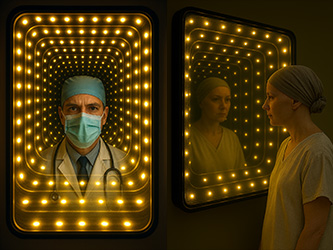
And so it goes with the pieces in this issue, in which we try to portray the reflected experiences of being a cancer patient as shared by some physician colleagues. Austin Sim, Christine Chung, and I do not presume that we (or any reader) can know exactly what Ross Camidge, Benjin Facer, Zsila Sadighi, or Bobby Mukkamala really see in the mirror, how they really feel. Our hope is that their stories give us at least some insight into their trials and tribulations, and by extension that might help us maintain our EQ, here meaning empathy quotient, for patients we see in our daily practices.
We are deeply grateful to Ross, Benjin, Zsila, and Bobby for opening up to us. I don’t have in my vocabulary a word that properly describes the wonder and beauty of their strength and grace through adversity.
Finally, a special word of thanks to this issue’s guest editor, Rachel Rabinovitch. Rachel and I have worked together in the same department for 25 years, during the last 10 of which our offices have been adjacent and separated by what seems a paper-thin plywood wall. And so even if we hadn’t become close friends and confidantes, we would still know each other’s business, because we can hear each other’s private, closed-door phone calls and conversations anyway, whether we want to or not. Full disclosure: I borrowed the mirror metaphor theme of this issue in part from the title of her 2022 ASTRO Presidential Symposium talk.5 Rachel is amazing in many ways, and her commentary should give you a glimpse of that.
References
- Bill was a radiation oncology resident at CU at the time and is now an Associate Professor at Emory. Hi, Bill!
- Tran JL. Yayoi Kusama: The underdog story of a Japanese art maverick. https://www.japantimes.co.jp/culture/2019/11/07/films/yayoi-kusama-japanese-art-maverick. Accessed December 17, 2025.
- It was an infinity mirror room called Phalli’s Field. You can Google it.
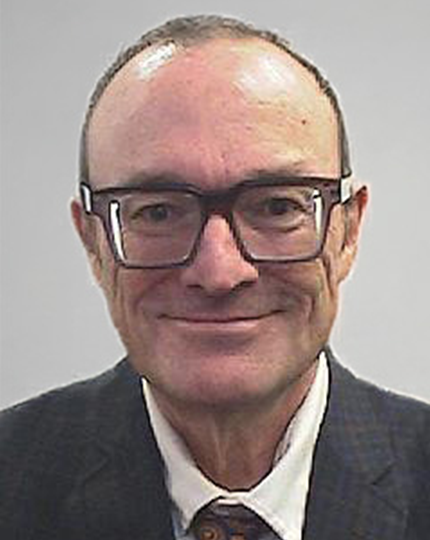
- I used Microsoft Copilot. For the record, the cover image is not AI-generated. It was a couple of digital photos of Ross Camidge taken by me outside, one with and one without the white coat, and stitched together with image processing software.
- Her title was “Looking in the Mirror: What I Didn't Know as an Oncologist Before I Was the Cancer Patient.” Of note “The Mirror Speaks” is the title of an amusing poem written in the late nineteenth century by Robert Louis Stevenson, not to be confused with the song “My Mirror Speaks” by Death Cab for Cutie.
Commonalities and Individualities
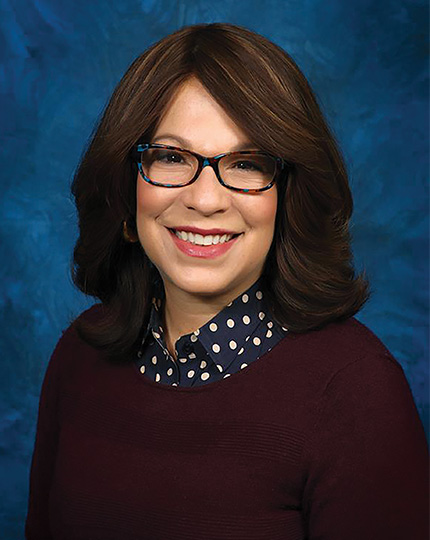
In a presentation I gave at the ASTRO 2022 Annual Meeting Presidential Symposium, I pointed out a personal observation filled with irony: the surprising frequency with which an oncology subspecialist is diagnosed with the very malignancy for which he or she has professional expertise.1 The majority of my own academic and clinical efforts have centered on breast cancer, a malignancy with which I was diagnosed not once, but twice (and no, I am not BRCA+). In “P.S. Your Shoes are Untied”, you will meet Ross Camidge, a world-renowned lung cancer expert. Would you like to guess what kind of cancer he has?
Dr. Benjin Facer (“The Hodgkin Mixtapes”) was diagnosed with lymphoma at an early age, and he describes his gratitude for the generous support of family and friends during the course of his treatment as an adolescent. While I was diagnosed as a 41-year-old with a family of my own, the common path is that a cancer diagnosis is a personal crisis on multiple levels. Its presentation does not usually involve an ambulance ride to the emergency room, but it's life-threatening all the same. As with anyone going through a crisis, one needs the support from as many types of resources as possible: family, friends, co-workers, community (religious or other), mental health professionals, etc. I was (and am) blessed with an amazing husband and a religious Jewish community that truly rallied for me. People showed up at my front door, arms outstretched, holding roasted chicken and potatoes as an expression of their love and support. These gestures were often more comforting than the meals I didn’t need to prepare for my three small children while exhausted from chemotherapy. Burdens are always easier to bear when shared with others.
Each doctor’s cancer experience influences their doctoring in a different way. It's uplifting to read about how Dr. Zsila Sadighi’s diagnosis as a teenager inspired her toward a career helping kids who face a challenge similar to what she herself experienced. It gives her great empathy to “Keep Cheering.” When I encounter newly diagnosed patients who feel overwhelmed and alone, I will selectively share that I too have gone through cancer treatment. We have all encountered patients who are skeptical that we, their caregivers, understand what they're going through or believe that we are making recommendations for reasons other than their personal benefit. I've had agitated patients yell at me that I don't understand what it's like to be treated with radiation or chemotherapy; so I share with them that, well, I actually do. Most feel comforted by this information; it creates trust and a unique bond.
Last but not least, we have our “Movie Star,” the charismatic AMA President and recent ASTRO Keynote Speaker, Dr. Bobby Mukkamala, who finds comfort in his Hindu faith. It’s often considered a taboo to speak of religious beliefs in the scientific medical world, but this is a common, deep and meaningful foundation for many. My religious framework provided great comfort yet raised questions as well. While I felt very grateful for how well I tolerated multimodality therapy, I also thought at the time of my second diagnosis, “God? What are you trying to communicate to me that I didn’t catch the first time?!” Perhaps I finally learned that I cannot control the world despite my type-A personality. And yes, some questions remain.
In the end, I am so incredibly grateful for my health and all that I have: three grown children and six grandchildren, a satisfying career and amazing colleagues. To me, it's all icing on the cake.
References
- Rabinovitch R. “Looking in the Mirror: What I Didn't Know as an Oncologist Before I Was the Cancer Patient". https://www.youtube.com/watch?v=6b9iuzB58zY. Accessed December 12, 2025.