Movie Star
Brian Kavanagh, MD, MPH, FASTROThe first thing you notice about Bobby Mukkamala is that he is handsome. In a parallel universe, Bollywood finds him at a younger age, and he becomes the next Shah Rukh Khan.1 In our own time-space continuum, Bobby was indeed eventually discovered and will appear in a forthcoming feature film. More on that later.
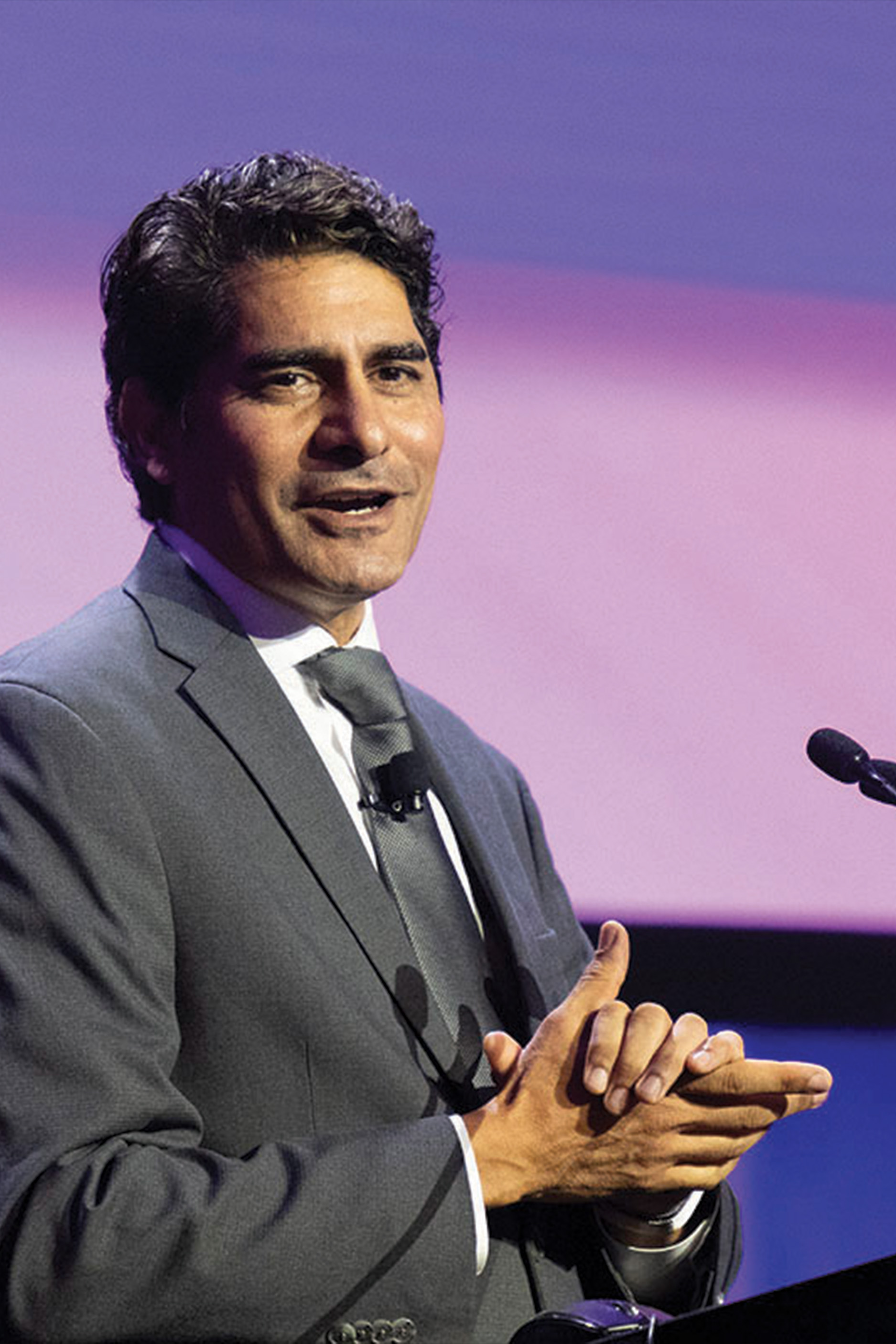
Dr. Mukkamala is a practicing otolaryngologist from Flint, Michigan, and current president of the American Medical Association. He has graciously shared intimate details of the medical diagnosis that shocked him and his family a little over a year ago, namely an IDH-mutant grade II astrocytoma, for which he had surgery and is now receiving vorasidenib. His journey is enriched with enlightenment.
A Confused Kid Finds Clarity
There was Catholic grammar school during the week, Bala Vihar classes on the weekend. Old Testament, New Testament, Bhagavad Gita, Moses, Jesus, Krishna, Rama, Brahma. A lot for a 10-year-old to wrap his head around.Dr. Mukkamala recalls wandering through this childhood spiritual labyrinth: “It was all comic books and stories that were really cool when you're young, and then eventually, in high school, a little bit of philosophy but never really any buying in at that point, right? I mean, all those things we did at that age were more like, OK, if there's a quiz or a test coming up, at least I'll know the answers as opposed to believing in those answers.”
And yet Dr. Mukkamala thinks that in retrospect, his upbringing provided fantastic preparation for the crossroads where he now finds himself. He describes an epiphany a few days after learning his diagnosis, when things that had been murky were suddenly thrown into sharp relief. The Hindu tenet of reincarnation, the belief that the physical body is just a temporary state, suddenly resonated as he recommitted to what he considers his important purposes in life: to be a father, to be a husband, to be a son, to be a community member, to be a leader in the House of Medicine.
“I will continue to do those roles, and whenever that ends, whether that's because I get hit by a car or whether because this tumor is no longer resectable or treatable, then this life will be over. I could come back as a cockroach for all I know, versus somebody that's a genius. I have no idea, but a lack of attachment to this body is something that has been amazingly helpful going through this because whatever happens, happens.”
Which is not to suggest that he is taking a passive approach to his treatment. He plans to be fully compliant with his doctors’ recommendations. “I'll do what I'm supposed to do. I'll let them cut out whatever they want to cut out, I'll do everything they tell me,“ adding with a wink, “otherwise my wife will get mad at me. But when it ends, it ends, and I'll move on.”
Noblesse Oblige in Small Town, America
In his Keynote address to the 2025 ASTRO Annual Meeting audience, Dr. Mukkamala expressed his profound gratitude for colleagues in his region and around the country who provided expert opinion and management at a moment’s notice once his diagnosis had been established. He deeply appreciates how his instantaneous access to world class healthcare is a privilege not enjoyed by everyone in this country, and he feels a moral and ethical responsibility as AMA president to move the needle toward better health equity. Affordable insurance is a part of that equation, as are other challenges.One frustration for Dr. Mukkamala and many others is that the United States spends a lot of money on healthcare, but the return on investment is questionable in terms of the population’s actual health. For residents of Flint like Dr. Mukkamala, the public health debacle of that city’s drinking water crisis and its threat to the well-being of the town’s children are a painfully fresh memory.2 In his opinion, there is a gaping disconnect between our outstanding hyperspecialized care involving expensive interventions and the lack of support for preventive, health-promoting care. As he puts it, “Amazing place if you've got a brain tumor. No better place on the planet to get that out and get it out fast. But there's more to our health than treating something that's already there.”
Dr. Mukkamala’s hope is that there would be a shift toward more emphasis on disease prevention, but he understands that it is hard to produce a sustainable business model for that, because so much prevention is simply, in his view, “from conversation... It's from exercise, it's from nutrition, it's from some medicines. And that knowledge is conveyed in a physician's office.”
A guy can still dream though. Dr. Mukkamala imagines a world where instead of seeing a drug company ad “every fifteen minutes,” we see a lot more public service reminders about healthy lifestyles featuring physical activities and sleep hygiene and balanced diets. “It would be amazing to see an advertisement for something about healthcare that isn't pharmaceutical-related.”
In his role with the AMA, Dr. Mukkamala can stand behind a mahogany podium before large audiences of his peers and proclaim policies and debate issues with other learned individuals. And there are a time and a place for that sort of grand forum. But he also cherishes an equally if not more important communication channel.
”I live in a small town. It's where I grew up. And so, on a daily basis, I see people I know everywhere. My teachers from high school. Neighbors. My mom is a retired pediatrician. At least a couple times a week, a patient comes in, and they tell me that they were my mom's patient when they were a kid. When I go to Home Depot, I see 10 of my patients there. I love that.”
Beyond just the bonhomie, Dr. Mukkamala sees value in these relationships for his ability to care for patients. “I think it helps us connect more when our patients know us. I think it gives them a little more confidence. Because then, when they see something on social media about how vaccinations will kill you more than COVID, and I am not just seeing them in my office for their earwax, but instead we are both at Home Depot, and they say, ‘Look at my phone. This is what it says. Is that true? Because I was vaccinated. Should I be scared?’ This is an amazing opportunity to have a conversation and help people understand the truth.”
The Siren Call of the Silver Screen
If you have never seen a Bollywood movie, I highly encourage you to treat yourself to one. There will be action, comedy, dancing, heroes with supernatural powers, dancing, snide villains who are often Englishmen, magical realism, and more dancing. You might want to start by streaming the film at home, since they can be a bit long, frequently north of three hours, and you will want to be able to insert an intermission or two.Through serendipity, random happenstance, or karma — take your pick — Bobby Mukkamala the accidental thespian was introduced by a friend of a friend to someone who was making a movie and needed one more actor for a minor role. Lo and behold, Bobby fit the profile beautifully for a part in the upcoming blockbuster Halagali: Blood of the Rebellion, which tells the tale of the brave uprising of the Beda community against the 1857 Arms Act.3 The producer thought Bobby would be perfect to play… wait for it…one of the British bad guys.
I will have my microwave popcorn ready to go the minute Halagali hits Netflix.
References
- SRK is the world’s wealthiest actor. If you don’t know his work, set aside 2 hours and 42 minutes and watch Om Shanti Om. You will become a fan.
- Flint water crisis. https://en.wikipedia.org/wiki/Flint_water_crisis. Accessed November 2, 2025.
- Halagali First Look Teaser. https://youtu.be/nYuiV5D7mrE. Accessed November 3, 2025.