Journals Highlights

RED JOURNAL
Operations and Impact of a Specialty-Specific National Incident Learning System: Ten Years of Radiation Oncology Incident Learning System (RO-ILS)
Ford et al.Incident learning is widely recognized as a key component of maintaining safety and quality in healthcare. In 2014, RO-ILS: Radiation Oncology Incident Learning System was launched by ASTRO and AAPM with the goal of facilitating safer and higher-quality care in radiation oncology. This review discusses the structure of the RO-ILS program, its foundations and operations, as well as outcomes in terms of engagement and learning opportunities.
Effects of Nutritional Interventions on Quality of Life in Patients with Nasopharyngeal Carcinoma Undergoing Radiotherapy Based on Dynamic Nutritional Risk Screening and Assessment: An Open-label Single-center Randomized Phase 3 Trial
Guan et al.Malnutrition is common among patients with nasopharyngeal carcinoma (NPC) undergoing radiotherapy and is associated with diminished quality of life (QoL). However, the impact of individualized nutritional interventions (NIs) on QoL improvement in this population is unclear. This study aimed to evaluate the effectiveness of NIs patients with NPC, guided by dynamic nutritional risk screening, in improving QoL and reducing malnutrition during radiotherapy.
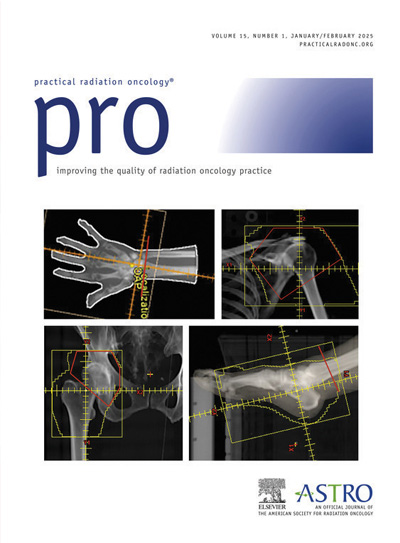
Practical Radiation Oncology
Immunotherapy in the Upfront Definitive Management of Locally Advanced Cervical Cancer: An Evolving Treatment Paradigm
Weil et al.Definitive chemoradiation has been the standard of care for locally advanced cervical cancer for almost 25 years, but despite advances in radiation therapy and brachytherapy techniques and approaches, survival outcomes generally remain poor. Two recent prospective randomized phase III trials, CALLA and Keynote A18, have explored the addition of concurrent and adjuvant immunotherapy to chemoradiation for treatment intensification. This Topic Discussion explores how different high-volume institutions have subsequently approached incorporation of immunotherapy into the management of locally advanced cervical cancer.
The Impact of Artificial Intelligence Auto Contouring on Resident Education
Qian et al.The integration of artificial intelligence (AI) auto contouring (AAC) in radiation oncology has streamlined the delineation of organs at risk (OARs). Assessing OAR contours has long been considered a vital skill in radiation oncology. This study assesses the impact of AAC on residents’ contouring education and skill acquisition and its consequences for educational programming.
Advances in Radiation Oncology
Neurocognitive Function and Quality of Life After Multi-fraction Radiosurgery for Large Resected and Intact Brain Metastases: Results of a Prospective Clinical Trial
Janopaul-Naylor et al.Stereotactic radiosurgery (SRS) is standard of care for brain metastases, providing effective local tumor control while avoiding the neurocognitive effects of whole brain radiotherapy. However, large brain metastases have been excluded from the randomized studies of single fraction SRS and there is limited data regarding neurocognitive outcomes with multi-fraction radiosurgery approaches for large intact or resected brain metastases. The authors performed a prospective Phase 1 dose-escalation study of multi-fraction SRS for intact or resected brain metastases 3-6 cm in diameter from 2012-2021.
A Comparative, Multi-Observer Analysis of Nodal Contouring Methods in Pelvic Online Cone-beam-based Adaptive Radiotherapy
Wang et al.In online cone beam CT (CBCT) based adaptive radiotherapy (ART), nodal re-contouring ensures sufficient nodal coverage by accounting for anatomic change but is uniquely challenging due to small target size and time pressure. This study evaluates the accuracy of rigid propagation vs. artificial-intelligence-guided deformation (AID) for nodal auto-segmentation via comparison to nodal re-contours delineated with unlimited time (i.e., benchmark contours).
Visit the journal websites for the latest articles and multimedia content:
www.redjournal.org
www.practicalradonc.org
www.advancesradonc.org