Keep Cheering
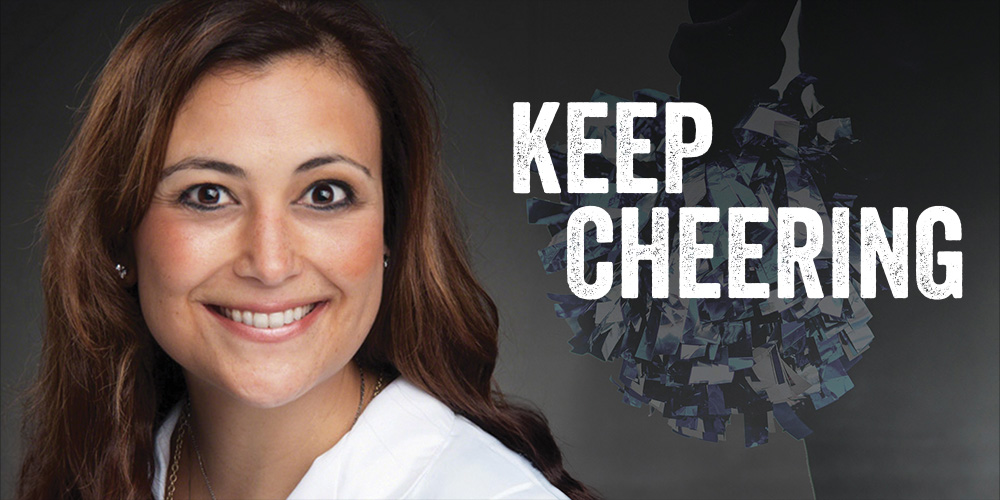
Christine Chung, MD, MPH, FASTROZsila Sadighi, MD, greets her pediatric neuro-oncology patients with a warm smile and a calm, cheerful demeanor. Her interactions with her patients reflect a deeper understanding of their experiences, shaped by her own journey as a cancer survivor.
The Diagnosis
When Zsila was 17 years old, a cheerleader and star student at her high school in Austin, Texas, she developed severe, daily headaches. She felt like there was a “bag of rocks” in her head, and she noted increased pressure when moving her head. Other family members suffered from migraine headaches, so she attributed her symptoms to migraines as well. On December 30, 1994, she had a terrible headache, accompanied by nausea and vomiting. She then experienced temporary loss of motor strength in her left leg.Zsila’s mother took her to a local emergency room, and she was diagnosed with a migraine. The hospital mandated a CT scan of the brain for all patients with headaches. After the CT scan, the ER doctor returned to her bedside with tears in his eyes. He told her that there was a mass that was “two-thirds the size of a Coke can,” extending from the right occipital lobe to the right frontal lobe. She then had a brain MRI, and the neurosurgeon on call recommended surgical excision.
Zsila didn’t initially comprehend the MRI findings, but she started trembling under the sheets of the hospital bed as the neurosurgeon described the surgery. She was terrified that she might develop permanent left-sided paralysis. Yet she took consolation from her Christian faith and felt confident that she would survive the surgery. She was convinced that “I wasn’t finished with my life.”
At that time, Zsila didn’t know that some of the physicians told her mother that she might not survive. She also didn’t fully understand that the surgery might leave her with intractable seizures. Her mother later told Zsila that this experience was the most difficult moment of her life.
New Year’s Resolution
Zsila underwent neurosurgical excision of the mass on January 2, 1995. The pathology showed an ependymoma, grade 2, and the neurosurgeon accomplished a gross total resection. She did not require adjuvant chemotherapy or radiation.The next morning, Zsila woke in the ICU and did a neurological self-exam in the hospital bed, wiggling her fingers and toes to check her motor skills. She was overcome with gratitude that she could move her extremities. She also sensed a new perspective in life, and she felt an “internal pressure to do something worthy in her life.” She was determined to live “to the fullest with passion, and to pay it forward.”
The experience also gave her a greater sense of appreciation for the people in her life. Her mother provided constant support, and Zsila also noted that “people came out of the woodwork,” rallying around her and her mom during that difficult time. She felt supported by her community, who buoyed her with love after her hospitalization.
Metamorphosis
Afterwards, Zsila returned to high school, but she felt different from her peers. She had acquired a greater sense of purpose and direction. Although her neurosurgeon assured her that she could return to cheerleading during her senior year, she decided to pursue her passion for medicine. Rather than returning to the cheerleading squad, she created an internship which allowed high schoolers to rotate at a local hospital.Although she was nervous before every restaging brain MRI, especially during the first five years after treatment, she gradually came to embrace the fact that she had been healed. She felt the peace of acceptance, and she remains “humble and thankful” that she has survived her cancer.
Zsila identifies the cancer diagnosis as a defining moment in her life, one which is now inseparable from her identity. She considers this time as a gift which changed the trajectory of her life. She had previously wanted to become a doctor, and this experience confirmed her desire. Her mother later told her, “How could you not become a doctor? This is the sign that you have been given.” Zsila ultimately became a pediatric neuro-oncologist, a career which combined her affinity for children with her fascination with neurology. She worked for St. Jude Children’s Research Hospital for six years and then moved closer to home, serving on faculty at MD Anderson Cancer Center for five years.
As a cancer survivor, Zsila feels that she offers a unique perspective and hope to her patients. She lets them know that there is ongoing research into novel treatments, providing new opportunities for a cure. She has a heightened sensitivity to the patients’ experiences, as she has been in their shoes. She is aware of their thoughts, the fears that she once shared: “Am I going to live? Will I be able to live out my dreams?” And although she acknowledges that some of her patients will not survive, she emphasizes that “every patient’s journey needs hope.”