

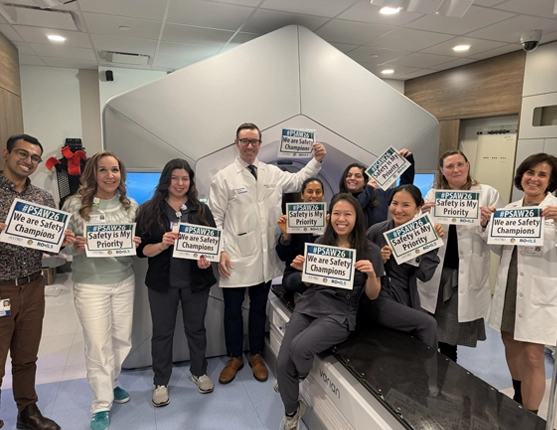
Patient Safety Awareness Week is an opportunity to reflect and spotlight our specialty’s commitment to always providing safe, high-quality care. In radiation oncology, safety is the foundation of our culture and woven into every treatment we deliver. Each radiation oncologist, medical physicist, dosimetrist, radiation therapist and staff member plays a key role in this mission.
Multiple layers of safety checks are embedded throughout the patient care process, and ASTRO offers a variety of resources to support safe treatment ,delivery, all driven by a shared goal of designing systems that prevent errors from ever reaching patients.
One core component of our safety portfolio is the Radiation Oncology Incident Learning System®. This specialty-specific reporting and learning platform allows practices to securely share and analyze safety events and near misses in a nonpunitive environment. The data generated from RO-ILS helps identify patterns, inform education and strengthen safeguards across the specialty.
Accreditation through ASTRO’s APEx Program for Excellence® enables practices to benchmark and refine quality standards. Facilities that earn the APEx designation have demonstrated adherence to rigorous quality and safety criteria, reinforcing the idea that excellence is intentional.
Education and evidence-based guidance remain central to sustaining the strong safety culture that is key to ASTRO’s mission. Our guidelines, safety white papers and consensus recommendations provide detailed guidance on best practices. For example, the recently published DVH compendium provides a variety of metrics for treatment planning across various disease sites and fractionation schemes. We are currently developing a white paper on the safe implementation of artificial intelligence in radiation oncology and updating guidance on peer review to reflect contemporary practice. These efforts demonstrate our commitment to providing best practices for leveraging advanced technologies to help patients.
As new technologies and treatment paradigms emerge, our safety infrastructure evolves as well. Recognizing the rapid growth of radiopharmaceutical therapy, ASTRO recently launched Authorized User (AU) Training Centers for clinicians to gain essential experience to safely integrate radiopharmaceuticals into their practice. This initiative is designed to strengthen the workforce and expand patient access to these innovative treatments.
ASTRO also offers practical tools to support teams. Our new onboarding checklists are available at no cost to help practices standardize orientation for new physicians, physicists and staff, reducing variability during critical transition periods.
Ultimately, safety in radiation oncology is about people, including every member of the care team and every patient who entrusts us with their care. As we observe Patient Safety Awareness Week, we celebrate the ongoing dedication of teams who advance safety through curiosity, ingenuity, transparency, teamwork and compassion. These values are core to the culture of ASTRO and the specialty we proudly serve.
Blog commenting guidelines
- Commenters are required to identify themselves by name. Email verification is required for first time commenters.
- Comments are subject to review and should focus on the content of the blog post or other posted comments. Comments that are commercial or promotional in nature, are not relevant to the blog for which they have been submitted or are otherwise inappropriate will not be posted.
- All defamatory, abusive, harassing, profane, threatening, offensive, pornographic, obscene or illegal materials are strictly prohibited.
- Providing any non-public information about ASTRO or any other company or persons without authorization is prohibited.
- To preserve a climate that encourages both civil and fruitful dialogue, ASTRO reserves the right, in its sole discretion, to delete posts or ban users who violate these rules.
