
Title
Whither, or maybe Wither, Social Media and Radiation Oncology?
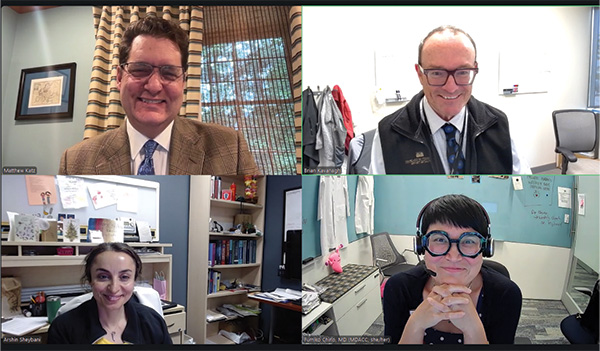
ASTROnews caught up with Drs. Fumiko Chino and Matt Katz, two of the most recognizable radiation oncology personas on a range of social media platforms. We wanted to hear their opinions about those communication channels, where they were and where they are now, why they are what they are, and how to approach them in the future. So here we go…
ASTROnews: Do you think social media is mainly a reflection of existing opinions, or does it actively shape and change them?
Fumiko Chino, MD (FC): I think nostalgia is a sinister impulse, but the old Twitter was an active community with lots of good debates. There was knowledge sharing, there was cross-pollinating of ideas.
Over time, though, that has deteriorated. Engagement — especially on platforms like what was Twitter — has become less constructive and more negative.
I also think social media is now so integrated into how people consume information that it's no longer possible to separate it from how opinions form. People learn about major events, news and culture through their feeds rather than traditional media.
Matthew Katz, MD, FASTRO (MK): I do think social media influences perceptions. When it started out, it just seemed exciting to exchange ideas, but over time it has tended to pull people toward more extreme positions — particularly on shorter format posting platforms. Because you can crystallize things, but it often simplifies things too much.
Around 2018, I started having more overt questions about it. After some of the elections that took place, and some increased rancor that I saw, I think it got worse in 2020, with the pandemic, which is totally understandable. I think that we haven't really fully recovered from that. And I'm not sure, at least for short form, if that will change. On other platforms like Facebook, people love learning and making decisions based upon peer input, and so, I don't think that it's inert. I think it's a dynamic process, and I'm not sure it's always healthy.
ASTROnews: Why does social media seem to promote polarization and extreme opinions?
MK: There are a few factors. People often respond on social media more emotionally than logically. Also, social media isn't truly "free." People tried to have different business models, but people did not want to pay. People wanted social media to be free. And so, arguably, we all ended up as the product.
There are pressures behind the scenes, the need to generate revenue from advertisers, for these social media platforms to remain viable. I do think that the way they keep people engaged is by keeping that emotional engagement, which often means anger or other things that may make you keep coming back or keep thinking about it.
FC: Fragmented focus plays a role too. I wash the dishes and listen to a podcast. My partner is on his phone while we're watching a movie. I don't even know if we're truly multitasking, we're kind of multi-nothing. I think that's just the existential crisis of our modern existence.
And so those strong stances fit a lot with that. To have a nuanced conversation requires sitting down and actually talking to someone, and having both ears open, as opposed to just sending messages back and forth.
It is very easy to reflect on the poorest intentions from the written word. Emojis help some, but the inflection is gone, right? So, you actually can up the ante by how you read it, and I think that a text-only format may be also one of the things that actually, weirdly supercharges the emotions.
ASTROnews: What are some benefits of social media in medicine?
FC: I think there's been incredible support provided, really strong communities created and reinforced online in various spaces, including Instagram groups, Facebook, X (formerly Twitter) even TikTok communities, where people with common histories will find each other. Let's say residents in radiation oncology or patients with breast cancer who were diagnosed during pregnancy. Really specific groups, and they're able to form tight communities, and make visible what was previously, I think, invisible.
I'm thinking specifically of the metastatic breast cancer community, the advocacy that's available when you have a united group of disparate people that can then bond together and form a mission and research priorities and even do fundraising… It is impressive.
That's even been incredibly positive for me, as a researcher thinking about identifying cancer patient populations and how to understand their specific and unique needs. Also, when I'm planning a session for an academic meeting, if I want a patient advocate, I know this person from Twitter, and if they're not the right person, maybe they can point me to someone within their network.
MK: There's a researcher from NYU, Clay Shirky, who has talked about what social media and these digital connections do — in good ways or bad, depending upon how you use it— is to lower the barrier to social action. It brings people together in communities of interest that otherwise would not be able to find each other. They can communicate in real time or asynchronously, so that it can be global and not related to geography. So it has tremendous power in that respect.
One example early that I had found when I was much more enthusiastic about social media is a group that many people are aware of called Radiating Hope. This is an organization that focuses on people who are involved in radiation oncology, love mountain climbing, and then use that as a motivator to help raise money to get linear accelerator software and equipment to people where they need it in underserved areas around the world.
Another example that happened on Twitter that was very successful, something that Fumiko is extremely involved in, is HCW vs. Hunger, which is healthcare workers against hunger, that raises money to help people who have no way to get food easily, and over the time that they've been operating, they've raised over $4 million.
It is run as a contest where you get healthcare specialists from different areas to team up and then compete in the common interest of something not about ourselves, but about helping others.
FC: Thank you for plugging Healthcare Workers vs. Hunger! Last year was our best year ever. We raised over a million dollars, and our team won!
ASTROnews: What is your opinion of the negative aspects of social media? And can you share your thoughts on the Student Doctor Network in particular?
FC: There was this era of SDN antagonism where the specialty of radiation oncology was being publicly spat on, aggressively and mean-spiritedly. I think it actually also kind of wound down some.But I think it does go to show that if you're not a bot, you eventually run out of energy. It could be five years later, but you just can't keep up that amount of vitriol. In terms of negativity, at a certain point, at least on Twitter, people who are aggressive or who do not make good faith arguments (or anonymous sock puppets who are only interested in dunking on people) just suck the oxygen out of the room. I have a low threshold to silence them because it was too annoying and it’s not constructive criticism.
MK: I think early on, SDN was very helpful. I found it really interesting to see about the residency programs, what people thought about them. I was recruiting for my private practice, so it was actually helpful to get some insight into what people were thinking about and what their concerns were.
I think as we hit issues with anxiety among program directors and residents, with the future of the specialty, it created a downward spiral, and there were people that would favor accentuating the negative and eliminating the positive, the opposite of what you want.
The other issue is it was long form, and it was a common place for people to go, and I think it was detrimental because people were there looking at different specialties, and it was bad for our specialty. So, hopefully, if that has lessened, it's a reflection of a better outlook for the specialty in terms of how people are feeling about it.
A related issue is the question of anonymity. People are increasingly, I think, feeling it is okay to be outspoken, and that kind of authenticity is promoted as a good thing. The problem is that it is good, until it bites you when that's used against your reputation at a later point in time. Even if you use an anonymous handle, it's still potentially discoverable, and then it can hurt you.
Now, anonymity sometimes can be helpful if you need someone to be a whistleblower for a serious issue. But if it's just for acrimony and trolling, you must be careful, because it's just a screenshot away, or some error away from you actually being found out as Dr. So-and-so, and then having a negative impact on your reputation and even your job.
ASTROnews: Any other final thoughts?
FC: When people ask me how do you start on social media, or should I start, one thing I'll mention is that I think it is harder now to get going, to get a following. It can be very frustrating for people who want to commit some time to this. The effort-reward ratio, unfortunately, has tipped more toward effort.
If you're really interested in providing education, starting a dialogue, furthering evidence-based medicine, then it's probably not being in a Twitter-style echo chamber. It's being on TikTok, or it's being on Instagram, it's creating stories. It's creating shareable content. And that really is different than firing off the perfectly worded 280-character burn of the latest ASCO presentation. So, if your intention is education, I think there's space there, because certainly there is a proliferation of misinformation by nonqualified individuals.
A progressive problem I've noticed also, because I've done research within social media, is that it's actually getting harder to do patient-facing surveys that are recruited for online. It's harder to find the patient population that you would like, and there are bots taking surveys now. They're called Ant Farms. It's basically impossible at this point, because you'll get so many fake responses.
MK: I agree that so much of social media has become monetized or compromised in ways like that.
But I think I come from a different direction, because I ended up on social media, partly for a different reason, which is having left academics and gone to community medicine, which I've loved now for so many years, the issue is trying to stay connected and engaged without being in academics. And how do I do that and learn and try to be a better version of myself? And so that's the purpose I've used it for, and I still think it has been of most value to me.
Social media, AI… these things are tools that we have to decide how we're going to use. And social media helped me be a better version of myself. For whatever reason, I was on at the right time, I've got tons of followers, but I really don't care about that. The question is, do you meet the right people? Do you meet the people that are aligned with your mission in life?
I think if we look at it as a tool to help be a better version of ourselves, it may be helpful to define where it is useful, and where it isn't.
Translating the Value of Radiotherapy for Different Audiences
Effectively communicating radiotherapy’s value involves connecting with a variety of stakeholders, each with different concerns, needs, interests and ties to the specialty. Below are audience-specific approaches to tailor messages about radiation medicine.
For patients and caregivers: Lead with reassurance and clarity.
Patients want to know whether radiation therapy can help them, what side effects to expect and how treatment may affect their daily life. Use straightforward language and emphasize how radiation treatments are precisely tailored to each person, planned and overseen by a highly trained radiation oncologist.
For policymakers: Emphasize access, value and patient outcomes.
Policymakers may not know that radiation therapy can treat many cancer types or that it is often delivered in community-based settings close to patients’ homes. Yet policy pressures threaten many patients’ access to affordable, high-quality radiation therapy care. Emphasize the consequences when care is delayed.
For hospital and health system leaders: Highlight quality, multidisciplinary care and strategic value.
Radiation oncology supports curative treatment, symptom management, clinical trials, quality improvement, technology adoption and coordinated care. Emphasize that a strong radiation oncology program is essential to comprehensive cancer care.
For reporters: Make the story understandable.
Reporters need concise explanations and context, delivered in quotable language. A reporter may simply need to understand what radiation therapy is and why it matters. Avoid jargon and explain why the issue matters now.
Radiotherapy’s value is clearest when it is tied to the needs of the person listening: reassurance for patients, access for policymakers, quality for health systems and clarity for reporters.
Radiation Oncology Messages That Work
PrecisionModern radiation therapy can target cancer with remarkable accuracy, often within a single millimeter, or the size of a sharp pencil point.
Try saying: “Today’s radiation therapy is carefully shaped and precisely targeted to treat the cancer while limiting exposure to nearby healthy tissue.”
Access
Patients need timely access to radiation therapy close to home, without unnecessary delays that undermine outcomes and cause added anxiety during a difficult time.
Try saying: “When radiation is recommended, timely access is essential. Patients should be able to start their treatment without avoidable barriers.”
Quality of life
Radiation therapy can control cancer while helping patients preserve function or maintain daily activities. Radiation therapy can relieve pain and other symptoms caused by cancer.
Try saying: “Radiation can help ease symptoms and provide meaningful relief for many patients, including those with advanced cancer.”
Cure
Radiation therapy is a curative treatment for many cancers, used alone or with other treatments.
Try saying: “For many patients, radiation therapy is a key part of the plan designed to cure their cancer.”
Collaborative care
Radiation oncologists work closely with surgeons, medical oncologists, radiologists, pathologists, physicists, therapists, nurses, supportive care providers and other specialists.
Try saying: “A strong cancer care team includes radiation oncology expertise from the start, so patients can consider the full range of effective treatment options.”
Organ preservation
For some cancers, radiation therapy can help patients avoid organ removal, preserving important functions such as speech, swallowing, urinary function or sexual health.
Try saying: “Radiation therapy can offer some patients an effective treatment option that helps avoid more extensive surgery and preserve function.”