
Charged Participles: Part I Preemptive Action
By Brian Kavanagh, MD, MPH, FASTRO
Lightning. Laser beams. Bombs. Fire.
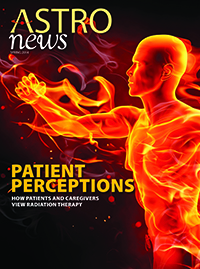
These are the fearsome images patients and caregivers associated with radiation therapy in an ASTRO-sponsored survey published in the Spring 2014 issue of ASTROnews. The cover art's Promethean aesthetic was searingly disquieting. The lay public's anxiety about radiation exposure extends beyond therapeutic applications into the realm of medical imaging, where high rates of worry have been observed in the general population and also specifically among cancer survivors.1, 2
Anti-Conspiracy Theory
Unfounded myths and misconceptions can be harmful to patients if they stand in the way of compliance with recommended care of net health benefit.3 In recent years, a groundswell of efforts to combat misinformation about radiation has emerged within the medical physics community. The American Association of Physicists in Medicine (AAPM) has launched ambitious initiatives in this regard.
Ehsan Samei, PhD, a former President of the AAPM, has been at the forefront of this movement. He points out the nuanced challenges of educating the public about a complex topic and cautions against the tendency toward what Bernard Shaw called "conspiracies against the laity," meaning the assumption that specialized professional knowledge can be wielded as a controlling power over the public.4
While it might be a straightforward task to create materials that are factual and — to the healthcare professional — perfectly suitable for educational purposes, Dr. Samei focuses on the principal aim: "Communication is more than just about projecting information. It is also making sure the information is effectually utilized."
As the principal investigator of a project enabled by the Patient-Centered Outcome Research Institute (PCORI), Dr. Samei has led numerous listening sessions with patients and providers. These sessions have exposed significant gaps in our radiation communication. For one thing, there is lack of consensus about who is responsible for such messaging. Furthermore, being dismissive of radiation risk has proven counterproductive. Saying "don't worry, it is not very much" will backfire.5 "The use of radiation in medicine is highly purposeful," adds Dr. Samei. "So, ultimately, the approach to radiation care communication should be one of respect: respect for that purpose, respect for the radiation, and respect for the agency of the patients in their care. Radiation should not be feared, but respected."
Super Radiant to the Rescue
Julianne Pollard-Larkin, PhD, might or might not have been the actual physical model of the AAPM's new educational superhero. But those of us who know her boundless energy and contagious optimism can confirm that she absolutely could have been the spiritual inspiration for the personification of positivity known as Super Radiant.
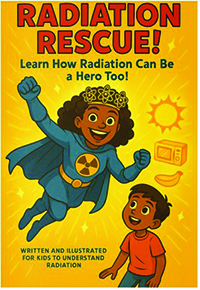
Although not yet featured in a series of Hollywood blockbuster movies,6 the Super Radiant League is a team of superheroes who helps kids understand radiation and its many salutary benefits. The AAPM's comic book series is intended to help younger patients needing radiation-based treatment or imaging to be more relaxed at the time of their procedures. The intent is for both the patient's psychological benefit and optimal quality of care, as Dr. Pollard-Larkin explains.
"One of the biggest issues that I have as a clinical physicist is when we get to simulation, and all the patients typically show some level of tenseness. That simulation is the most important aspect of preparation for radiation therapy, because we are determining exactly how they'll be set up for the entirety of their radiation treatment course. We create immobilization devices to hold them rigidly in that position. So if as a patient you're coming in tense, you're nervous, you don't understand what's going on, and every time somebody starts a radiation procedure, even if it's just imaging, they run out of the room, but tell you to stay still? It all heightens the feelings and emotions these patients have."
And every radiation oncologist knows the downstream impact when a patient is anxious and twitchy as treatment preparation happens but later, maybe halfway through a treatment course, now feeling more trust in their team, they are more comfortable and less fidgety. That is a good thing, but often then their anatomy settles into a different configuration which makes it harder to achieve the planned setup positioning.
Dr. Pollard-Larkin believes we can smooth over all of that. "If patients had a better understanding of the rigor that we put into understanding exactly how much radiation dose they're being given for each of the steps of the process, and how we double-check this on a daily, monthly and annual basis, then they would truly have a sense of empowerment as they went through the procedure, and it would allow them to relax."
The Blind Side
Anuj Kapadia, PhD, is also deeply involved in the AAPM's public education efforts. He traces the roots of the problem to the many random streams of information, both true and false, that bombard the public. "So much of the knowledge about radiation risk comes from science fiction. People watch movies and documentaries about the horrors of radiation and formulate negative ideas about how radiation can be harmful. Unfortunately, there aren't similar positive resources that describe how radiation can be used in a good way."
Dr. Kapadia sees the problem as double-edged. "In my opinion, the concept of radiation risk communication falls in two parts: One is about the message that we communicate; and the other, equally important, is about how that message is communicated? As with any form of communication, the message requires both parts to reach its true impact. We, as clinicians and physicists, possess deep expertise and information collected over decades of insights into this subject. We cannot expect a patient to gain the same level of confidence from a brief conversation with us."
The AAPM first approached these questions with a large-scale, multi-year, resource-intensive project designed to figure out what's worth communicating, how it should be communicated, and where the problems of communication lie. The AAPM-PCORI project led to some surprising insights: "We were just blindsided," notes Dr. Samei.
The first key observation was that no two patients are created equal when it comes to their outlook and context of care, and that issue goes beyond just the adult-child cohort distinctions addressed by the Super Radiant comic books. Effective communication demands flexibility, according to Dr. Samei, who adds, "That includes accommodating different contexts of different patients, to be receptive to patients' specific landscape and situation, to accommodate the personhood of the person receiving the information."
Another lesson from the AAPM's efforts was that it was unclear to patients who is responsible for radiation care-related communication. Where should they turn for more information? Do they go to the radiation oncologist, the medical physicist, the technologists, the dosimetrist, or the receptionist at the front desk and ask the question? To make it even more confusing, it is not settled among radiation health professionals who is ultimately responsible when it comes to relating to patients about the radiation aspects of their care.
Website, Workshops, Wordification
So where does the AAPM begin to teach? Let's start with www.medicalradiationinfo.org, which serves as the entry portal for public education about Medical Physics.
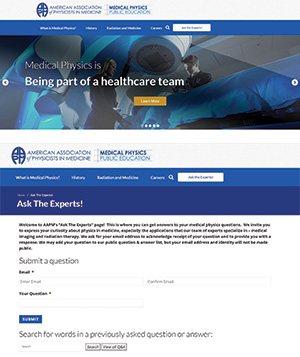
The slide show at the top of the page links to general topics describing the role of medical physicists, but for a deeper dive into specifics, follow the "Ask the Experts" link7, which is partly sponsored by the American Institute of Physics. Here, the reasonably tech-savvy (defined as having an email address) patient or caregiver can input any question about radiation or can search the database of previous Q's & A's. Answering the questions are AAPM member volunteers who give a correct and understandable answer. A planned enhancement to the site is a series of videos accessible here and anywhere else that seems appropriate that will serve as an easily accessible primer on radiation for the public.
And there will be workshops. Plans are underway for a radiation care communication workshop at Duke University on October 19-20, 2026, open to all radiation care providers. Another is in initial stages to possibly be held at the ASTRO Annual Meeting in 2027. These workshops will offer a new approach and commitment to provider education: the content and methodology of communication, the what and the how. Case studies, role playing, audience participation: it can't just be passive, because the hope is that providers will put their knowledge into action.
Finally, yes, there is hope that eventually large language models8 will play a meaningful role. It will take a bit more persuasion of his colleagues, but Dr. Samei thinks there is tremendous potential to construct an interactive repository of knowledge with the capacity for personalized exchanges. As he puts it, "while radiation care communication needs to remain a human dialogue, the beauty of a large language model is that it can be trained to be an ally in the process — it can accommodate whether I'm a surgeon, or if I am a minor person, or if I am a scared-of-radiation-type person. A large language model can adapt the response according to what the patients need."
References
- Hay JL, et al. Prevalence and correlates of worry about the health harms of medical imaging radiation in the general population. Journal of Primary Care & Community Health. 2016 Oct;7(4):219-25.
- Hay JL, et al. Prevalence and correlates of worry about medical imaging radiation among United States cancer survivors. International Journal of Behavioral Medicine. 2018 Oct;25(5):569-78.
- Brody AS, Guillerman RP. Don't let radiation scare trump patient care: 10 ways you can harm your patients by fear of radiation-induced cancer from diagnostic imaging. Thorax. 2014 Aug 1;69(8):782-4.
- The coinage by Bernard Shaw traces to his play, The Doctor's Dilemma, which has a morally complex plot structure and a main character of dubious professionalism. But all discussions of Shaw will stop right here lest we go down some dark rabbit holes. Let's just say his views on eugenics and vaccinations are polemical. ¡Ay, caramba!
- In one survey, a paltry 6% of patients were satisfied with the commonly used statement that "risk is low" if used in isolation. Davies E, et al. Survey of the publics' preferences for communication of medical radiation risk. Journal of Radiological Protection. 2022 Jun 1;42(2):021506.
- My agent says I have a decent shot at landing the role of the archvillain Leadhead, so I am going to enroll in acting classes at Schwarzenegger Academy.
- Ask the experts! www.medicalradiationinfo.org. November 16, 2021. Accessed May 29, 2026. https://www.medicalradiationinfo.org/ask-the-experts/.
- I did not invent the term wordification. To my knowledge it first appears in the title of this paper about Hitchcock movies and Slovenian traffic. Perovšek M, et al. A wordification approach to relational data mining: Early results. In: Late Breaking Papers of the 22nd International Conference on Inductive Logic Programming 2012 (pp. 56-61). https://ceur-ws.org/Vol-975/LBP-ILP20…Accessed May 25, 2026.
Meet the Medical Physicist: Imaging and Radiation Therapy
In this recent joint ASTRO and AAPM episode of the On Target patient podcast, host Julianne Pollard-Larkin, PhD, leads a conversation with medical physicists and physicians from radiology and radiation oncology. The panel demystifies imaging and therapy doses, contrast media safety, CT versus MRI, linear accelerators, treatment planning and when proton therapy or brachytherapy may be the right choice.
On Target was created to help patients and their caregivers learn more about what to expect during radiation treatment and better understand their treatment options. Episodes focus on different cancers and treatment methods. Hearing directly from trusted experts such as physicians and medical physicists helps patients get accurate, evidence-based information in clear, understandable language. It also builds confidence by reassuring listeners that their questions and concerns are being addressed by the professionals who guide cancer care every day.
Visit astro.org/OnTarget.