
Title
Charged Participles: Part II Character in Crisis Management
By Tim Williams, MD, FASTRO
As a volunteer leader for ASTRO, I had the privilege of serving as the Chair of the Board of Directors in 2010. I had previous experience on other voluntary boards, from which I learned that there were two things a new chair dreaded most. The first was that your CEO would resign. If that happened, your entire year would be spent searching, interviewing and securing a new, hopefully capable, individual who would then serve the Board Chair that followed you. Alone, this would be bad enough, requiring mountains of effort attempting to stabilize and redirect the Society so the next chair could steer it in their desired new direction.
But that is not the worst thing that could happen. The worst thing that could happen would be if, as a new Board Chair, a reporter from 60 Minutes showed up in your office one afternoon "with some questions for the organization."
Well, as fate would have it, something like that happened to me. A few weeks after the ASTRO Annual Meeting, we [ASTRO] were told that the New York Times prepared a series of articles concerning the safety of the use of radiation in medicine. None other than Walt Bogdanich, the two-time Pulitzer Prize winning investigative journalist, had learned of a serious misadministration at a major New York hospital that had fatally injured a young professional. Walt and his team began investigating the potential risk of both diagnostic and therapeutic radiation and had discovered some disturbing issues.
The initial article was published the Sunday before my first Board meeting, the winter meeting, to be held in Napa Valley.
The first time I read the article was four days before the meeting started. Not ideal.
The first step was to recognize the crisis. This article involved real people in a terrible situation and was not something that ASTRO could deflect, suppress or minimize. We — the specialty, the organization, the Board — were going to have to deal with it. In serious matters like this what matters most is not so much what office you hold, but who you are as a person. Here I was fortunate to have learned a vital lesson in my youth from my Scoutmaster. Literally around the campfire, he shared with us that there were going to be times in our lives when we were going to have to stand up and do the right thing, no matter how hard it was going to be and no matter what the consequences were. Well, my 12-year-old self listened to him, and here we were.
Fortunately, I had scheduled extra time in the Board meeting agenda, so we reorganized the schedule to allow as much discussion as needed to develop a plan. As we began, I explained to the Board that we should behave as if the entire membership, and by extension all of society, was outside the room's scenic picture window watching us, evaluating us, judging us, as in a sense they were.
We had three days. The first day we had an exhaustive discussion regarding what happened, how it happened, and why it happened. There was already much literature available for our review, and we reviewed it. We concluded that, in general terms, there was no systemic, recurring issue with safety. The risk of any individual person being seriously injured during a course of therapeutic radiation was measured by one in millions, on par with level one anesthesia, the airline industry, or nuclear power generation. But we still knew there was much work to be done.
The second day we discussed what we needed to do to make the specialty safer still. The fact that the risk to any individual patient was statistically extremely small is no consolation for someone who might actually be injured. It was out of this discussion that the Target Safely1 initiative emerged. This six-point plan led to actionable, verifiable metrics and served as a model for moving forward.
On the third day we reviewed the action plan, discussed the six aspects further, and all questions were resolved. The motion to accept the plan was accepted unanimously by a roll call vote. It was also moved that we engage immediately with the AAPM, and their efforts were critical to the plan's acceptance and rollout.
The New York Times article received national attention, and we learned that Congress was going to hold hearings on the matter. ASTRO actively responded to the scrutiny, with aspects of the six-point action plan already coming out. Fortunately, ASTRO's then CEO, Laura Thevenot, was highly experienced in government affairs. She connected me with a consulting firm, and they guided me through the process of testifying.
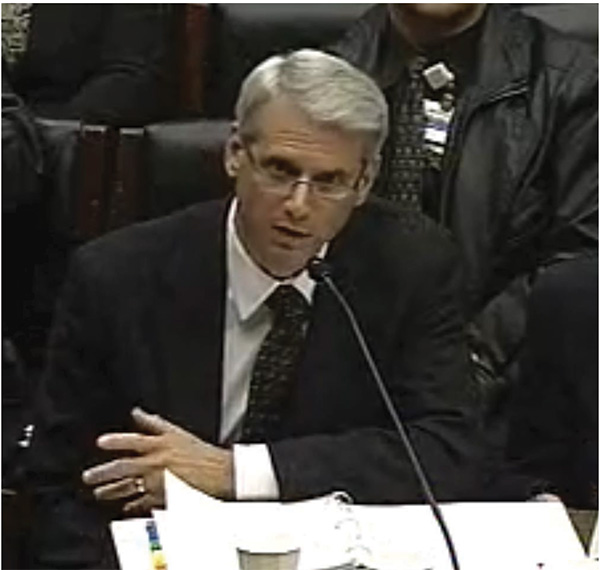
Congressional hearings2 are performative affairs wrapped in political theater. At the table, you are given three minutes to make a statement. This is followed by questions, if there are any, by the committee members in attendance, if there are any of them. My well-rehearsed speech went two minutes and 53 seconds. There is real risk, though, because if provoked the committee has great power. If you are careless, or don't take the process seriously, your entire specialty can find itself trapped in a spiderweb of new, expansive federal oversight. In my case, only a handful of committee members were present, and the responses to the questions were relatively straightforward, armed as I was with our comprehensive action plan specifically designed to make sure that a similar misadministration never happens again. I will always be grateful to Laura and her network of consultants, who guided me through the process.
My Board deserves most of the credit, as they took a serious, thoughtful look at a significant problem and faced it head-on. For three days we revisited the entire process-of-care of radiation treatment, focusing on improvements. They were focused, deliberative, diligent and committed to success. We can all be proud of the work they did. Also, great credit goes to the AAPM, who partnered with us to create the policies and procedures that made the program work. Over time, with the help of their efforts and support, the Target Safely program became ingrained into the culture of the specialty.
In the end, the specialty became safer. To my knowledge there has not been an error even remotely as serious as what happened when this review began all those years ago.
And my final thank you goes to Mr. Godson, Scoutmaster Troop 411, Doraville Presbyterian Church, for that campfire speech about standing up and doing the right thing, that a 12-year-old boy still remembers to this day.
References
- American Society for Radiation Oncology. Target Safely. astro.org. 2010. Accessed on June 18, 2026. https://www.astro.org/practice-support/quality-and-safety/target-safely
- YouTube. A Hearing on "Medical Radiation: An Overview of the Issues" (Part 2). February 26, 2010. Accessed on June 18, 2026. https://www.youtube.com/watch?v=LnZtATqUGPI
Combating Media Misinformation
Radiation oncology is often misunderstood, and misinformation in the news or on social media can leave patients feeling anxious and confused. Below are tips to help shift the conversation, by correcting misconceptions clearly and consistently, whether online or in media interviews.
Avoid repeating negative framing, even to refute it. Repeating negative or misleading language can reinforce it, and anything you say can become a soundbite. Lead with an accurate or affirmative message instead, such as: “Modern radiation therapy is designed to treat the cancer while protecting as much healthy tissue as possible.”
Address common misconceptions proactively. Reporters and patients may not know that radiation therapy is different from chemotherapy, that side effects are usually localized to the treatment area, or that hair loss typically occurs only when the scalp or brain is treated. Proactively naming these points can provide clarity and minimize confusion.
Use patient-centered language. People are more likely to trust information they can understand. Replace technical terms with everyday language whenever possible, such as “side effects” instead of “toxicity,” or “number of treatments” instead of “fractions.”
Emphasize the physician-led care team. People may picture a machine rather than the highly trained team behind each treatment plan. Reinforce that radiation therapy is prescribed, planned and overseen by a radiation oncologist working closely with a specialized team of cancer care professionals.
Bridge back to what matters most. If a question puts you on the defensive, answer briefly and redirect to your key message: “What I think matters most for patients is…”; “Let me put that in context…”; or “What I’ve seen in practice is…” The goal is not to avoid difficult questions, but to keep the focus on accurate, useful information.
Remember that everything is on the record. Try to avoid sensational, defensive or exaggerated language that could become the headline. A calm, factual tone helps build trust and keeps the focus on patient care.
Offer trusted resources. When asked where to find more information, point patients and reporters to physician-authored, patient-friendly materials from Speed of Light – The ASTRO Foundation.