The Marshall McLuhan Mantra
By Brian Kavanagh, MD, MPH, FASTRO“After three thousand years of explosion, by means of fragmentary and mechanical technologies, the Western world is imploding…Today, after more than a century of electric technology, we have extended our central nervous system itself in a global embrace, abolishing both space and time as far as our planet is concerned. Rapidly, we approach the final phase of the extensions of man — the technological simulation of consciousness, when the creative process of knowing will be collectively and corporately extended to the whole of human society, much as we have already extended our senses and our nerves by the various media.” — Marshall McLuhan1
These lines from “Understanding Media: The Extensions of Man” could have been written last month, or today or next week. They would still feel immediate. Prophetically, they were written over 60 years ago, by the man who coined the phrase “The Medium is the Message.”
In this issue of ASTROnews, we explore modern communications media. We learn from leaders in the field of radiation oncology who have either studied how best to convey information about radiation to the public or gained practical insights from a mix of positive and negative experiences. In the two-part “Charged Participles,” some friends from the AAPM tell us about revelatory surveys, and 2022 ASTRO Gold Medalist Tim Williams remembers a harrowing PR crisis. Amar Rewari gives us a glimpse of the bright lights of national TV exposure. Two of our favorite social media gurus, Matt Katz and Fumiko Chino, reflect on where that morass has settled. Plus a couple of other side stories along the way.
A Canadian philosopher-academic2 who pioneered the field of media theory, McLuhan conceptualized media in a broader sense than just the available means of exchanging facts and fiction. Instead, he viewed a medium as “any extension of ourselves” that could include all manner of technology or expression that support or enable actions beyond basic human capacity. He was interested in what he viewed as previously unexamined “psychic and social consequences” of such extensions.
His major opus is not an easy read. It is at times a trippy stream-of-consciousness rant with many sound bite-sized excerpts from philosophers and literary luminaries and historical figures whose familiarity with modern readers might be faded at best. For the pithiest possible TL/DR summary, here are a few of the chapter titles: “Clothing: Our Extended Skin,” “ADS: Keeping Upset with the Joneses” and “Press: Government by News Leak.”
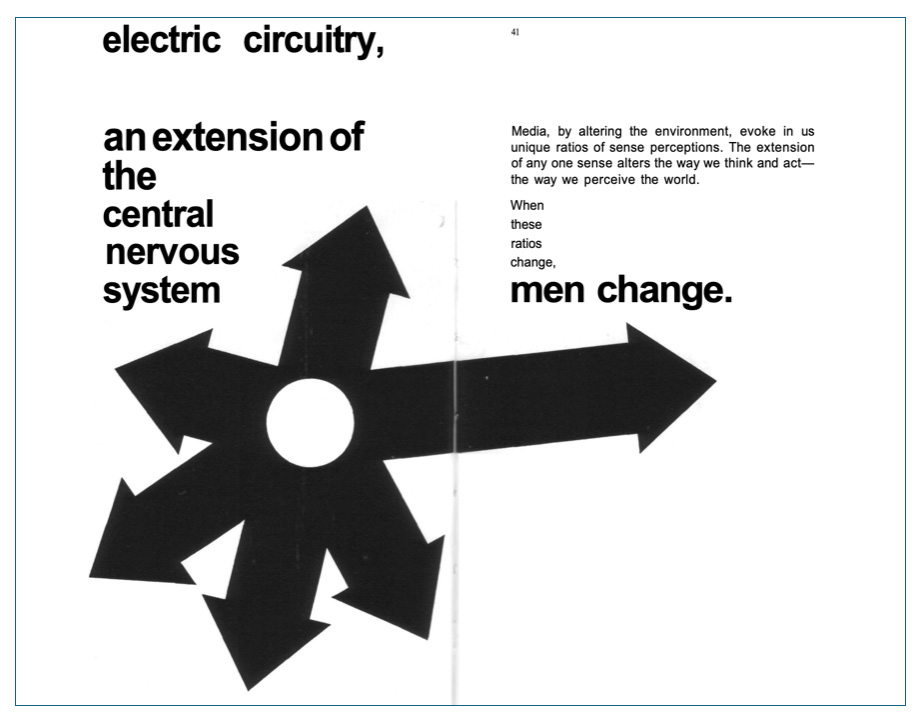
Even more psychedelic is McLuhan’s follow-up best-seller, The Medium is the Massage. Yes, that title really was a typesetting error by the printer. However, McLuhan did not insist on a correction and in fact embraced it, since he felt it was “right on target”,3 perhaps because it added a multi-sensory vibe of interactivity. As illustrated in one of the book’s many composite graphic image-text montages, McLuhan believed that media could, ultimately, effect change.
OK, enough of a magical mystery tour.5 How does anything McLuhan wrote relate to the modern world of radiation oncology and the challenge of massaging our messages through various media to represent the field in the best possible light? I offer one reductionist answer.
Our messages transmitted via communications media are extensions of our collective selves. What we say and how we say it convey values and personality and impressions that resonate beyond the spoken or written words.
This issue is partly intended to whet your appetite for this year’s Annual Meeting, where ASTRO President Neha Vapiwala’s theme will be “Data to Dialogue: Communicating Radiotherapy’s Value to Advance Care.” I hope to see you in Boston!
References
- McLuhan M. Understanding Media: The Extensions of Man: The New American Library (Signet Books).; 1964.
- Spiritual inspiration for David Palma, Laura Dawson, David Jaffray, or other colleagues from the Land of Maple Syrup? Not sure, you have to ask them.
- McLuhan, M., Fiore, Q., & Agel, J. (2001). The medium is the massage. Gingko Press. In the public domain. Accessed June 12, 2026. https://archive.org/details/pdfy-vNiFct6b-L5ucJEa.
- Commonly asked questions about McLuhan – the estate of Marshall McLuhan. Marshall McLuhan. Accessed June 12, 2026. https://marshallmcluhan.com/common-questions/.
- Unsurprisingly given the contemporaneity, there has been academic discourse on the relationship between McLuhan and The Beatles. MacFarlane T. The Beatles and McLuhan: Understanding the Electric Age. Scarecrow Press; 2013.
Facing Dr. Gemini: Patient communication in a noisy digital world
By the time a patient walks into your clinic, they’ve already met their other oncologist. Not the one down the hall. Not the colleague across town. Not the subspecialist at a comprehensive cancer center. The one on TikTok. The one with perfect lighting, impeccable confidence, and absolutely no hesitation about explaining why ivermectin deserves another look.
Every oncologist practicing today recognizes the phenomenon. Patients arrive carrying not only pathology reports and imaging studies, but screenshots, podcasts, YouTube clips, Instagram reels, Facebook support-group wisdom, and enough conflicting information to make a multidisciplinary tumor board seem refreshingly straightforward.
Cancer has always attracted myths. What has changed is the speed, scale and sophistication with which those myths travel. We are no longer communicating in an environment where physicians, academic centers and professional societies serve as the primary gatekeepers of medical information.
Instead, we practice in a marketplace of ideas where evidence-based recommendations compete directly with personal anecdotes, viral content, commercial interests and, increasingly, deliberate disinformation.
And even if this makes us nostalgic for the past, we cannot abandon the digital public square because our patients have not.
Unfortunately, the practice of medicine isn’t easily converted into a 280 character post and clinical oncology involves uncertainty. We discuss probabilities rather than guarantees, relative risks rather than absolutes, and tradeoffs rather than perfect solutions.
In keeping with ASTRO’s Annual Meeting theme, this quarter’s issue is dedicated to communicating our discipline to the public. Despite all the challenges, there are radiation oncologists who are successfully entering the fray. We hope their stories inspire us all to become active participants in public discourse or at least give some tips the next time you encounter Dr. Gemini in your clinic.