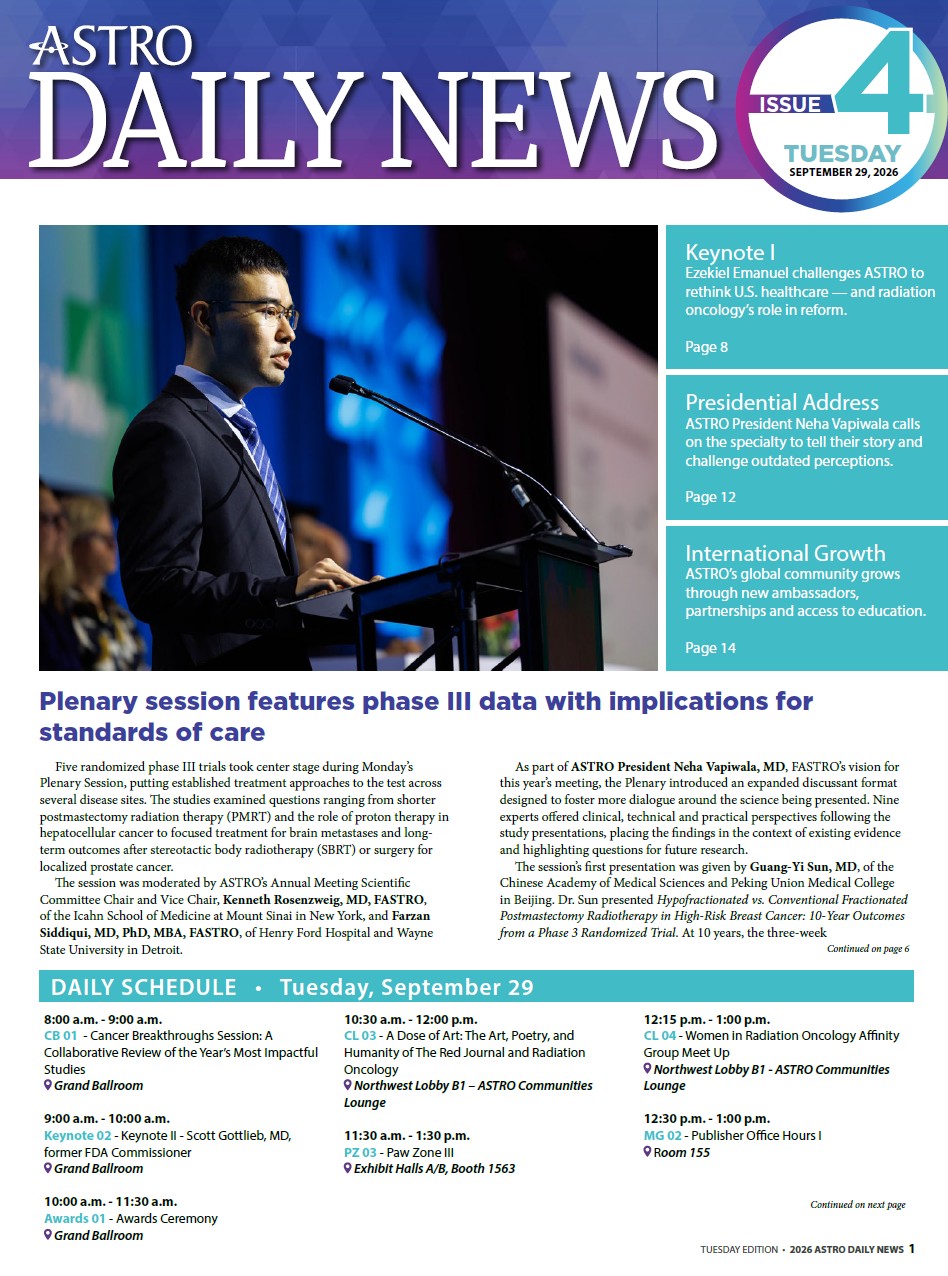
Today’s Daily News reports on the Plenary session, ASTRO President Neha Vapiwala's call to members, Keynote Ezekiel Emanuel and more from ASTRO 2026. Plus additional expert commentary on studies from the meeting in the Daily News email.
Monday’s Plenary Session featured five randomized phase III trials spanning breast, liver, brain and prostate cancer, with implications for standards of care.
Keynote speaker Ezekiel Emanuel, MD, PhD, outlined five goals and an eight-point plan for reforming the U.S. healthcare system and radiation oncology’s role.
In her Presidential Address, ASTRO President Neha Vapiwala, MD, FASTRO, urged the field to move from data to dialogue in communicating radiotherapy’s value.
Alliance A071801 found fractionated SRS boosted surgical-bed control over single-fraction SRS for resected brain metastases, with an unexpected survival signal.
NRG-CC009 addresses a long-standing evidence gap in brain metastasis management for patients with small cell lung cancer, directly comparing stereotactic radiosurgery with hippocampal avoidance WBRT.
Initial results from the phase III NRG-GI003 trial show proton therapy did not improve survival over photon radiotherapy in advanced hepatocellular carcinoma.
An integrated biomarker study suggests Rb1-S780 phosphorylation may identify aggressive grade 1 meningiomas that could benefit from adjuvant radiation therapy.
A multicenter deep radiomics study links CT imaging phenotypes to distant metastasis risk and tumor biology across 3,421 patients with head and neck cancer.
American Society for Radiation Oncology
251 18th Street South, 8th Floor
Arlington, VA 22202
Telephone: 703-502-1550 www.astro.org