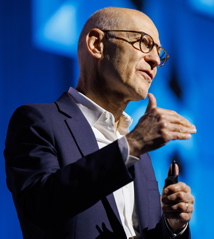
Ezekiel Emanuel, MD, PhD
By Jennifer Jang, MHS, ASTRO Communications
Ezekiel Emanuel, MD, PhD, Vice Provost for Global Initiatives and Co-Director of Healthcare Transformation Institute, University of Pennsylvania, took the podium following the introduction of fellow New Trier High School graduate, Charles Thomas, MD, FASTRO, of Dartmouth Cancer Center. With an array of degrees from Amherst to Harvard, Dr. Emanuel has made significant stops that include the White House, contributing to the Affordable Care Act and the COVID Advisory Board. Along the way, he has authored a myriad of publications and offered expertise on news channels and within academia.
Dr. Emanuel shared “The American Care Compact: Goals for Future Health Care Reform,” opening with, “If you can’t become a radiation oncologist, you can at least talk to them.” And “talk to them” he did, engaging the audience first with a poll, finding that the majority of the audience finds prior authorization to be “pretty terrible.” And while most of the room was willing to pay up to $25,000 for health insurance, reluctance was evident.
Dr. Emanuel established the problem clearly and quickly. He responded with five goals for a well-functioning healthcare system: universal coverage, reasonable and sustainable costs, consistent care, reduced disparities, and satisfaction of the public, patients and providers.
The challenge of universal coverage is depicted by 28 million uninsured Americans. National health expenditures (NHE) are over $5.3 trillion, and the U.S. healthcare system is the third largest economy in the world. Forty percent of American adults have healthcare debt, and for every $6 in someone’s wallet, one goes to healthcare.
On the brighter side, in quality, the U.S. leads in cancer care. For most cancers, the five-year net survival remains among the best globally. But the U.S. fails in other areas of chronic care, including diabetes and myocardial infarction (MI), alongside substandard data in infant and maternal mortality and life expectancy.
The broken system
Dr. Emanuel defined the three original sins that have led to such fractures:
1) fragmentation of coverage leading to fragmentation of payment and quality care 2) dominance of hospitals and specialists focused on acute care, which shortchanges preventive care and mental health and 3) fraying of the social safety net.
There is a fundamental disconnect between the diseases killing Americans and the ones that the healthcare system best treats. Hospitals and specialists are poorly equipped to prevent illnesses or manage chronic conditions. Yet 52% of American adults have two or more chronic illnesses.
Money is not the problem
With $5.3 trillion spent on healthcare, or 18% of GDP, money is not the problem. Dr. Emanuel presented his most-used graphic, showing GDP per capita on the x-axis and health consumption spending per capita on the y-axis, in U.S. dollars. When plotting countries such as New Zealand, France, Switzerland, etc., the line is relatively straight, and the U.S. is an outlier, way above other countries, with almost $15,000 spent per person. If the U.S. met Switzerland at $10,000 per person, that would represent $5,000 more back in the pockets of an individual, and a significant $20,000 more for a family of four.
If money is not the problem, what is? He retorted, the problem is how the healthcare system is designed, and what individuals are not giving up. Dr. Emanuel asked ASTRO — as a group of radiation oncologists, what are you willing to give up? How, then, do we fix the American healthcare system?
Some areas to consider include drug costs. Dr. Emanuel suggested finding savings by eliminating drug deductibles, co-insurance and copays, oncologists giving up being paid more for prescribing more expensive drugs and instead receiving a flat fee for administering chemotherapies, and pharmaceutical companies pricing drugs based on health outcomes.
Meanwhile, hospital costs account for almost a third of healthcare spending, and since 2000, have nearly tripled. Administrative costs represent 25-30% of healthcare spending. Eliminating administrative burden could save at least $265 billion per year. That means a savings of over $770 for each American on their insurance premiums.
Overall Reform
Dr. Emanuel asked the audience to engage in a thought experiment: even if we halved drug costs to create $400 billion in savings, it would still represent less than 10% of overall spending. Because massive, isolated changes like this won’t solve the broader problem, he instead proposed eight points for reform:
Dr. Emanuel challenged the audience to figure out what they’re willing to give up to realize the goals of an improved healthcare system.
Where does radiation oncology fit in?
Dr. Emanuel understands the field’s concerns, including reimbursement models, practice closures, accessibility of new therapies, and the administrative and cost burden of reporting quality measures. ASTRO’s ROCR model is a great step, he shared, with bundled per-patient episode payments that are fraction neutral, offering more stable reimbursement to keep clinics open.
Dr. Emanuel also suggested that AI will take away manual processes, and decrease wait times for patients to access treatment. It won’t eliminate jobs, only speed up the process.
With that rich contribution, Dr. Thomas followed with some overarching questions. When asked what keeps him up at night, Dr. Emanuel reiterated, that for one in six dollars to go into healthcare is unacceptable. And the restoration of trust is that much more urgent. “The breakdown of trust is not irrevocable, but to reverse it, we need to show that we can make changes for the patient’s benefit and fight the notion that the system isn’t working for them. This perception is dangerous and hard to overcome. People want authenticity and not talking points.”
Dr. Thomas bookended his introduction, noting that in leaving this meeting that “we don’t lose enthusiasm for action.” Dr. Emanuel responded, “Hope I’ve provoked some good thoughts” – an understatement to an incredibly provocative keynote.
Published on: September 29, 2026