By Haidy Nasief, PhD, MS, Medical College of Wisconsin

Improving cardiac event prediction for patients with Locally Advanced Non-Small Cell Lung Cancer (LA-NSCLC) is possible by leveraging the ability of medical foundation models to provide alternative representations of medical images. These models are pretrained on very large and diverse medical imaging datasets and can provide image representations, often referred to as embeddings. Rather than training a model from scratch for every single task, we can extract these representations and evaluate if they contain useful information for a downstream clinical endpoint.
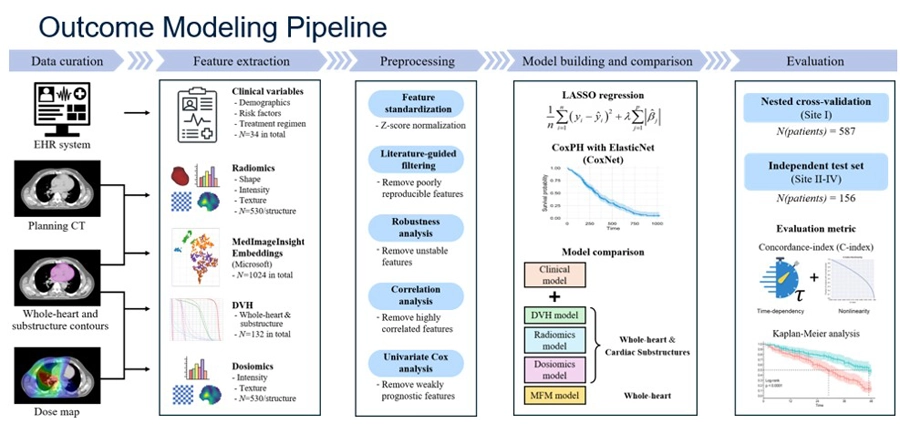
Xin Tie et al. presented at the ASTRO Annual Meeting an innovative way to go beyond conventional whole-heart (WH) and cardiac-substructure DVH metrics, which were not significantly associated with cardiac events and can limit the cardiac risk prediction in contemporary LA-NSCLC treatment. The investigators incorporated state-of-the-art medical foundation models along with radiomics and dosiomics. They created an outcome modeling pipeline shown in the figure below to retrospectively analyze 743 patients with LA-NSCLC treated between 2010 and 2021 across four hospitals. Patient data from Site 1 (n=587) were used for model development and internal testing through fivefold nested cross-validation, whereas data from Sites 2-4 (n=156) were held out for independent testing. Focusing on major adverse cardiac events (MACE), the investigators used elastic net-regularized Cox regression in an outcome modeling pipeline incorporating clinical variables, WH/substructure DVH metrics, radiomics, dosiomics, and MedImageInsight (MII) embeddings.
The clinical-only model performed reasonably well internally (C-index: 0.72±0.02), but its performance dropped significantly in the independent test cohort (0.66±0.01). A similar pattern was observed for the radiomic and dosiomic models. The DVH-based model showed limited performance in both cohorts. In comparison, the model combining clinical variables with medical foundation-model embeddings showed more consistent performance between the internal and independent cohorts, with a C-index above 0.73 in both (internal: 0.74±0.02, independent: 0.73±0.01). Adding DVH or dosiomic features to clinical variables did not improve performance, and substructure-based outcome models did not outperform WH-based models. In the consolidation immunotherapy subgroup, the clinical + MII model significantly stratified patients into low- and high-risk groups (log-rank P=0.004), while the clinical-only model achieved borderline statistical significance for risk separation (P=0.05).
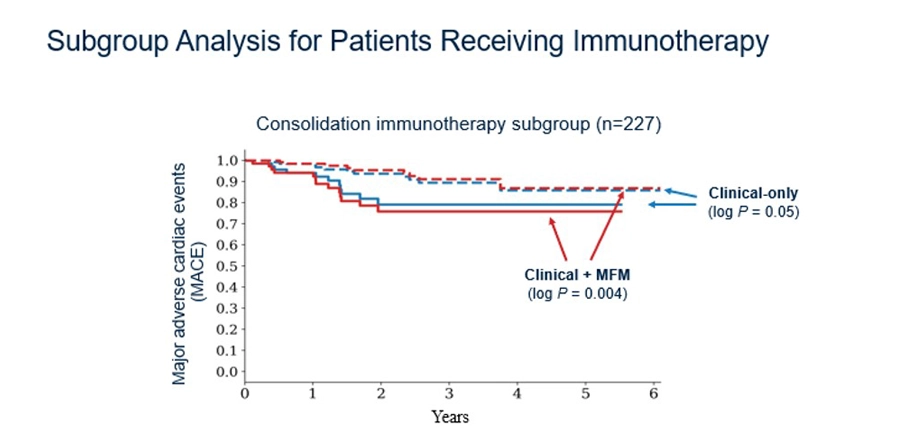
The authors of the study showed that foundation-model embeddings improve prognostic performance beyond handcrafted features, with the primary benefit observed on the independent test set.
These findings support the idea that advanced imaging representations can enhance cardiac risk assessment and enable more individualized cardiac-sparing strategies leading the way to future research with large-scale prospective validation of AI-derived imaging metrics and evaluating medical foundation models for additional clinically relevant endpoints.
Abstract 309, Beyond DVH: Radiomics and Medical Foundation Models Improve Cardiac Event Prediction in Locally Advanced Non-Small Cell Lung Cancer, was presented during SS 38: Imaging Biomarkers, at ASTRO's 68th Annual Meeting.
Published on: September 30, 2026