
By Jennifer Jang, MHS, ASTRO Communications
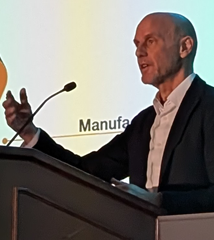
Stephen M. Hahn, MD, FASTRO, Chief Executive Officer and Board Chair of Nucleus RadioPharma and former Commissioner of the U.S. Food and Drug Administration, opened the inaugural Multidisciplinary Radiopharmaceutical Therapy Symposium with Keynote I: Accelerating Innovation and Reimagining Health.
Dr. Hahn set the stage with two key questions: how do we get great ideas into the hands of practitioners? And, how do we drive the future of innovation around radiopharmaceutical therapies (RPT)?
A lesson for anyone regardless of setting: teamwork and leadership matter. Establishing the right culture and the same and correct “north star” are critical, for every step of product innovation. “Broken cultures drive normalized deviancy.” Conversely, “extraordinarily performing teams are the ultimate advantage for any organization. Leadership matters. Inspiring leadership is the single biggest factor in achieving extraordinary results.”
Dr. Hahn shared his experience working at MD Anderson Cancer Center, a place where he saw mission drive the institution, where “the commitment of positive leaders keeps mission and purpose at the forefront of the organization’s consciousness. The leader’s vision transcends mission and purpose, recognizing that these are fluid concepts in a dynamic universe.”
Dr. Hahn then posed the question, “What if…in response to our most urgent unmet medical needs, we were able to develop interventions within one to two years?” Pre-COVID, the time period for vaccine development was around four to seven years, from the identification of a viral sequence to the authorization of vaccine. For COVID, innovation accelerated, shrinking that usual time period to 11 months, showing what is possible when urgency for maintaining health accelerates research and medical product development.
Dr. Hahn shared characteristics of the FDA during the COVID-19 epidemic. He observed that the resilience at the FDA was borne out of culture, values and communication, staying focused on their north star, acknowledging the fear, and knowing that what matters ultimately is the response. Communication had to be bilateral. He noted: “The agency took a lot of hits, there’s always a wrong decision to be made. Despite all the noise that went on during this time, I believe the agency did a good job of getting medical products out to folks.”
Dr. Hahn observed additional factors that contributed to rapid development of a vaccine, including a robust private sector coupled with an environment that supports and fosters innovation. The response to COVID showed what is possible, with the potential for innovation being even greater when driven by the moral imperative of eliminating healthcare disparities, imagining a world where we are able to expedite the development of medical products for everyone.
However, trust in public health agencies has diminished, with lower trust related to the belief that health recommendations are politically influenced and inconsistent. The least trusting also have concerns about private-sector influence and excessive restrictions with an overall low trust in government shared Dr. Hahn. This decrease in trust serves as a big hurdle to overcome, especially when big science is viewed with suspicion. “In order to build truth, we have to tell the truth.”
On the industry side, the U.S. “de-risked” industry to create the COVID vaccine. The government took the risk, prepping syringes early in the pipeline in order to be able to easily flip from authorization to administration of vaccine, contributing to the prevention of three million deaths and 18 million hospitalizations. However, another consequence is that the knowledge of side effects was not yet available. But with over a hundred thousand Americans dying every one to two months, the risk calculation took on a different emphasis. Through this crisis, the FDA’s north star was still to help the American people, with priorities including safety, efficacy, proper manufacturing, and not being distracted by externalities. The vaccination program saved the country more than $1 trillion in medical costs, got children back in school, and allowed for reopening of businesses and other activities. The innovation accelerated thanks to basic science research that was already in place for novel vaccines (mRNA), a vibrant private sector, regulatory flexibility, and federal funding (Operation Warp Speed) and de-risking of development costs.
Looking at RPTs, Dr. Hahn noticed challenges for agents due to a confluence of logistical, financial and competitive barriers. These have included logistical and operational complexity, such as radiopharmaceutical handling, complicated treatment protocols, manufacturing and supply-chain challenges; financial and reimbursement issues including high cost and low compensation.
The Mayo Clinic is the top prescriber of RPTs, and they surmounted these barriers by establishing Nucleus RadioPharma. In general, most RPTs are given at academic centers; however 80% of patients receive care via community oncology practices. Getting drugs into the hands of providers is important. Partnerships with providers in the community oncology setting will be essential. “We are seeing the regulatory state change for RPTs, and we will be seeing more image-driven dosimetry and image-driven dosing for RPTs,” said Dr. Hahn. “It’s important to anticipate trends and develop solutions.”
As such, Dr. Hahn demonstrated that radiation oncologists have a huge role to play. This is a space where he envisions rad oncs as authorized users helping as many patients as possible, coming to them first for RPT administration. Better access should lead to increasing the number of clinical sites, more hospitals with RPT capabilities, and improved access to novel medications. Currently the science is ahead of the supply chain. Lack of facilities, expertise and innovation have hampered the industry’s development.
Steps for success translates into strong partnerships, anticipating regulatory changes, collaborative customer relationships, a data-first approach, manufacturing growth strategy, and becoming the partner of choice. Dr. Hahn concluded with a call to the following priorities to advance innovation and reduce disparities:
Published February 18, 2026