By Jennifer Jang, MHS, ASTRO Communications
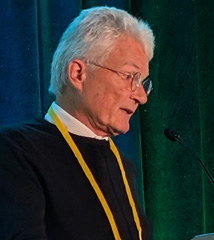
Johannes Czernin, MD, Department of Nuclear Medicine and Theranostics, Chief of the Ahmanson Translational Imaging Division at UCLA Health, presented yesterday’s second keynote: Radiopharmaceutical Impact Review: Patients, Performance, Potential and People. Introduced as a “foundation builder,” this felt especially true as he announced that the first Department of Nuclear Medicine and Theranostics officially opened its doors a few weeks ago at UCLA. And how? He described it as an achievement due to the “enthusiastic support of radiation oncology, urology and radiology…integrating and bringing people in from radiation oncology and urology to co-lead the program.”
This growth began with a few singular roots in 1941, with the first studies exploring hyperthyroidism, in a study led by Saul Hertz, MD, with few responders likely due to underdosing patients, but with a patient that had a remarkable recovery treated by radioiodine. Fast forward to today, “there are new targets and new approaches coming, but one has to be extremely careful with patient selection and focus on the one with high target expression.” Dr. Czernin cited a paper from the Prostate Cancer Foundation that gives an overview of PSMA and its discovery and translation to the clinic. But here he also gave his plea for basic science. When support is halted for the basic sciences, and the fundamental research, there will be nothing to translate.
With that, Dr. Czernin delved into the achievements and challenges for prostate cancer, sharing that the unequivocal success story has been in imaging. With research findings, key imaging probes became available along with guidelines, together which led to great success for the utilization of PSMA imaging patients with prostate cancer.
Regarding the current environment, he listed FDA-approved radiopharmaceutical therapies in oncology, along with new targets that provide an opportunity for both academia and industry to explore further, including different agents for imaging, and a variety of compounds. Time is needed to cultivate understanding, as he shared the evolving discovery and translation of PSMA from 1987 to now. “Everything we are doing originates in the basic/translational sciences and translation can take decades.”
The great challenge is therapy resistance, which led Dr. Czernin to the idea of integration between what nuclear medicine is doing and what radiation oncology basic scientists and oncologists are also doing. He stated the need to devise rational combination therapies, which involves looking at DNA damage response inhibitors and immune checkpoint inhibitors to name a few. Dr. Czernin resolved that this is going back to the basic sciences, using appropriate models to discover which kind of treatment is preferred for a small volume vs. large volume disease, and looking at what is the best timing and the best sequencing, for the best combination approaches.
Dr. Czernin noted pivotal diagnostic studies, followed by just as pivotal therapeutic studies, with a special focus on success and challenges, very good but not yet great. A major challenge remains of the largely unknown survival benefits. Dr. Czernin offered examples of general RPT questions to keep asking, such as how to optimize patient selection, explore the effectiveness of the number of cycles offered, to what extent is quality of life improved, how to identify patients at risk for renal toxicity, whether rechallenge is effective. Can we use treatment holidays to reduce toxicity risk? Will early use improve overall survival?
Dr. Czernin moved into the implications for business, patients and existing turf wars, ending with the opportunities and obligations for the field.
RPT in prostate cancer has proven to be a commercial success. In turn, Dr. Czernin explored whether the demand, of say, 100,000 patients can be met, and cited the growing need for physicists, technologists, nurses, radiation safety individuals, etc. The idea of turf needs to evolve to one where the delivery of theranostic services is integrated, patient-centric and not field-specific. “It’s not a specialty’s turf when patient needs are what make up its substance and should be the driver.” As such, decisions need to be made for the patients with competence as the priority. He conveyed that nuclear medicine/radiology can oversee the diagnostics using imaging biomarkers and determining treatment eligibility. Who delivers the therapy can vary, including nuclear medicine specialists, radiation oncologists or a combo. Patient management needs to be integrated, led by competent and licensed professionals.
Dr. Czernin’s example of integration at UCLA provides a tangible model, ranging from joint efforts in leadership (including joint academic appointments), joint tumor board, joint clinical research leadership, nuclear medicine sponsoring theranostics fellowships, and contributions to the radiation oncology curriculum that incorporates RPT.
Dr. Czernin concluded with an evaluation of theranostics in report card style, giving “Opportunities” the only A for novel targets, combination therapies and improved patient selection, with diagnostics following closely behind with an A- for its rapid growth in PET tracers and target specific imaging. Other areas ranging from therapeutics, integrated care, turf battles and obligations received a smattering of Bs and Cs, and a “Competent Workforce” elicited a D as much work remains to bring everyone up to speed including training sites, the front desk, nursing, technologists, etc.
Published February 18, 2026